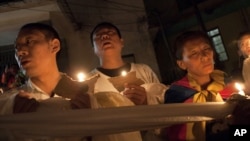
Reports from Tibet say another protester demanding Tibetan freedom has set himself on fire, bringing the number of Tibetans known to have self-immolated to 54.
Sources in Tibet say a father of two, Sangay Gyatso, 27, set himself on fire in eastern Tibet near the Dokar monastery, on Saturday. He is believed to have died.
On Thursday a Tibetan writer named Gudrup died in a self-immolation in Nagchu.
And on Friday the leader of Tibet's government-in-exile, Prime Minister Lobsang Sangay, said his government is willing to engage in dialogue with the Chinese government about autonomy for Tibet anytime. But he added that he does not expect any clear indication in how China wants to approach Tibet until after Chinese leadership changes later this year.
Sangay Gyatso's actions bring the number of self-immolations to 54 since February 2009 and are part of a slowly growing number of such incidents taking place within the Tibet Autonomous Region. Most of the self-immolations have occurred in southwestern China.
China has repeatedly denounced self-immolations as terrorist acts, calling the practice barbaric. But representatives of spiritual leader the Dalai Lama and the prime minister of the Tibetan government-in-exile say the practice is a sign Tibetans can no longer tolerate Beijing's push against their culture and religion.
Lobsang Sangay told a gathering in Dharamsala, India last week, "The fact that Tibetans, after 50-plus years, are still protesting, and in [the] drastic form of self-immolation, clearly indicates that they are protesting against the occupation of Tibet and the repressive policies of the Chinese government."
Sources in Tibet say a father of two, Sangay Gyatso, 27, set himself on fire in eastern Tibet near the Dokar monastery, on Saturday. He is believed to have died.
On Thursday a Tibetan writer named Gudrup died in a self-immolation in Nagchu.
And on Friday the leader of Tibet's government-in-exile, Prime Minister Lobsang Sangay, said his government is willing to engage in dialogue with the Chinese government about autonomy for Tibet anytime. But he added that he does not expect any clear indication in how China wants to approach Tibet until after Chinese leadership changes later this year.
Sangay Gyatso's actions bring the number of self-immolations to 54 since February 2009 and are part of a slowly growing number of such incidents taking place within the Tibet Autonomous Region. Most of the self-immolations have occurred in southwestern China.
China has repeatedly denounced self-immolations as terrorist acts, calling the practice barbaric. But representatives of spiritual leader the Dalai Lama and the prime minister of the Tibetan government-in-exile say the practice is a sign Tibetans can no longer tolerate Beijing's push against their culture and religion.
Lobsang Sangay told a gathering in Dharamsala, India last week, "The fact that Tibetans, after 50-plus years, are still protesting, and in [the] drastic form of self-immolation, clearly indicates that they are protesting against the occupation of Tibet and the repressive policies of the Chinese government."
Some information for this report was provided by AP, AFP and Reuters.