



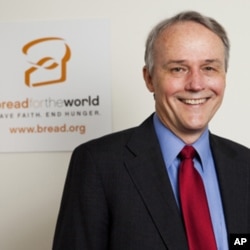
A leading voice in the worldwide fight against hunger is praising a new U.S. aid strategy aimed at improving food production in developing nations.
In its 2011 Hunger Report, the advocacy group Bread for the World says the initiative known as Feed the Future may be the best opportunity in decades for the U.S. to make significant progress against global hunger.
In the past, Bread for the World has been critical of U.S. foreign policy for failing to focus on poverty reduction.
But the group's president, David Beckmann, described the report as "a 200-page hooray" for the Obama administration's Feed the Future program, a three-year, $3.5 billion commitment to focus development assistance on agriculture.
The aim is to reduce poverty and malnutrition in 20 countries by boosting the productivity of small farmers and the agriculture industry.
On-the-ground decision making
At a press conference in Washington, DC, Beckmann noted that Feed the Future is different from previous development efforts because, for one thing, the people receiving the aid set the priorities for how it will be used.
"Makes sense, but it's hard to do, and it's often not been done," he said.
To win Feed the Future backing, country governments, businesses and civil society groups decide where they want to invest resources. That could mean school nutrition programs, access to seeds and fertilizers, developing rural infrastructure, or other ways to improve food security.
Country governments and the U.S. government then develop a strategy to achieve the goals.
Beckmann, winner of the prestigious World Food Prize, says he is especially pleased Feed the Future measures progress by examining rates of child malnutrition.
He added, "We're trying to get agricultural growth of a kind that will reduce poverty and hunger. So it makes sense to try and track whether it's really working by checking whether, in fact, babies are better nourished."
Moderate goals
The U.S. Agency for International Development oversees Feed the Future. At the press conference, USAID Administrator Rajiv Shah took a realistic tone about the program's goals.
"Nearly a billion people will go to bed hungry tonight," he said. "We're not proposing that we're going to eliminate hunger in a five-year period."
Shah said in the short term, Feed the Future aims to help end food insecurity in five to 10 countries. So far, he said, USAID has reviewed plans from five countries that would help 6.5 million households.
"If there are six and a half million families out there that will not have to suffer from acute malnutrition for a child because of this program, then that's six and a half million households that will just have a completely different life experience."
Shah added that success for those households could rekindle a wider sense of optimism in the fight against hunger.