



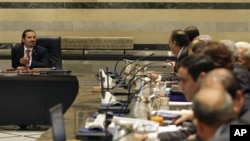
Syria and its political allies in Lebanon continue to exert pressure on the government of Prime Minister Saad Hariri, in what analysts say is another attempt to put an end to the international tribunal investigating the assassination of former Prime Minister Rafiq al Hariri.
Lebanon appears to be facing more political tension and a possible governmental crisis as Syria and its allies flex their muscles in a show of force against the pro-Western parliamentary bloc behind Prime Minister Saad Hariri.
Speaker of Parliament Nabih Berri, who is aligned with both Syria and the militant Hezbollah, is threatening to boycott the government unless it agrees to discuss a topic aimed at discrediting the international tribunal investigating the assassination of former Prime Minister Rafiq al Hariri.
'False witness'
Berri's spokesman, Ali Hamdan, insists the move is intended to clarify the situation and to debate the issue of false witnesses, which he argues was investigated by Lebanon's Minister of Justice, but tabled by the government.
"In mid-August, the Council of Ministers asked the Minister of Justice to prepare a report regarding the false witnesses in the Hariri case, and till now the report is ready, and till now the prime minister and the council of ministers [has not] asked to see the report and trace the issue."
Syria has been waging a rear-guard action against the tribunal, accusing it of fabricated testimony. In August, Hezbollah chief Hassan Nasrallah used another line of attack, replete with satellite photos, to allege that Israel had a hand in Hariri's killing.
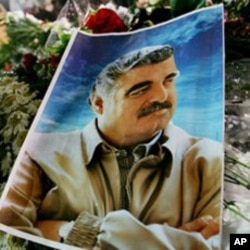
Leaders of Lebanon's pro-Western March 14th parliamentary bloc have repeatedly accused Syria of masterminding the 2005 assassination of former Prime Minister Hariri, in addition to a number of deaths of other political opponents.
Syrian ally Hezbollah took control of parts of Beirut in May 2008, after a long and protracted struggle with the government of then-prime minister Fouad Sanioura. A political deal, mediated by Qatar, and further Syrian pressure after June 2009 parliamentary elections, allowed Hezbollah to enter the government.
Hezbollah's intention
A number of Lebanese analysts have worried openly that Hezbollah, backed by Syria, is planning another attempt to topple the government, following reports that the international tribunal was about to accuse the group of involvement in Hariri's assassination.
Former member of parliament Mustapha Allouche, an ally of Prime Minister Hariri, believes Hezbollah and Syria will do everything possible to stop the tribunal.
"Everyone expects that something bad is going to happen," he said. "However, everyone is also cautious about what is the next step after the bad things happen. This is why everyone believes that if the opposition will boycott the government, most probably this will be a step in the void. The Syrians do not want the tribunal. They are trying politically to stop the tribunal."
Allouche is not sure if Syria is prepared to use force to stop the tribunal, but Khattar Abou Diab, who teaches political science at the University of Paris believes that the possibility exists and the international community must act to forestall such a development:
He says that Hezbollah, in league with Syria, appears to be exerting all sorts of pressure to force the international community to abolish the tribunal, even though this is impossible, since it would need a resolution of the U.N. Security Council, and the tribunal is above international and regional pressure. He says Hezbollah may attempt some sort of military action.
Abou Diab worries that Lebanon is caught in mounting regional conflict between Sunni and Shi'ite Arabs and urges the international community to prevent a new conflict from erupting.