Lebanon Tries To Contain Spillover of Syria’s Civil War
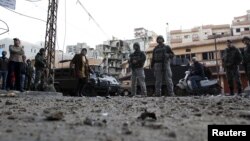
Residents and Lebanese army soldiers inspect damage following days of clashes between Sunni Muslims and Alawites in the port-city of Tripoli, northern Lebanon, December 10, 2012.
BEIRUT —
The Lebanese Army tried Monday to impose martial law in Tripoli, Lebanon's second largest city, after a spillover of Syria’s sectarian violence claimed 17 lives.
The violence in the northern city came after about 20 Lebanese volunteers crossed into Syria to join the rebels, but were killed by Syrian government forces in an ambush.
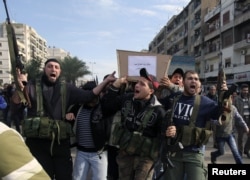
Lebanese Islamist gunmen fire their weapons as three bodies of other members of their group arrive from Syria, in Tripoli in northern Lebanon, December 9, 2012.
As the bodies came home to Tripoli, Lebanese Sunnis attacked Lebanese Alawites, accusing them of collaborating with Syrian Alawites, who control Syria’s army.
Kamel Wazne, a political analyst in Beirut, worries that Lebanese are lining up for and against Syria’s President Bashar al-Assad.
“As the situation in Syria deteriorates further, the situation in Lebanon will follow,” he predicted. “As we see tension escalate in Syria, we see more tensions here.”
But Paul Salem, director of the Carnegie Middle East Center in Beirut, believes the fighting in Tripoli reflects the besieged position of Lebanon’s only major community of Alawites, cousins of the Alawites who have run Syria for decades. He traces the tensions to Syria’s 30-year occupation of Lebanon, which ended in 2005.
“There’s a lot of bad blood since the days of the Syrian presence in Lebanon,” Salem said. “Obviously now that the Sunni in a sense in Syria are trying to topple the Alawite-dominated Assad regime, and the fact that unfortunately the main party in the Tripoli enclave is very connected to Syrian intelligence.”
Some streets of Tripoli now resemble the battle-scarred urban landscapes in neighboring Syria and scores of people have been wounded in the exchanges of gun and rocket fire by the feuding sides.
But Salem and other analysts believe that memories of Lebanon’s 15-year civil war are too fresh to allow Lebanon to pulled into Syria’s civil war.
"The Alawites are surrounded and certainly there’s a great potential or risk for wider massacres, wider killings,” Salem said Monday. “It is very serious in itself, but it doesn’t translate into directly into Sunni-Shia fighting in other places.”
Inside Syria, fighting continued for Damascus, the nation’s capital. Rebels tried to cut off the international airport. Heavy righting also raged in two northern suburbs.
Outside Aleppo, Syria's most populous city, a major government base fell to the rebels. A video posted online showed them seizing military vehicles, including a tank.
Slim hopes for a political solution dimmed when Russia, Syria’s principal supporter, said it would not support calls for Syria's President Assad to step down. Russian Foreign Minister Sergey Lavrov repeated Russia’s longstanding position that Syria’s political future should be decided by Syrians.
Exposure can be by inhalation, ingestion and skin absorption; people can recover with treatment form mild or moderate exposure
VX
Odorless, tasteless man-made nerve agent; most potent of all nerve agents
Slow to evaporate, can last for days on objects
Exposure can be through skin contact or inhalation; people can recover with treatment for mild or moderate exposure
Mustard Gas
Chemical warfare agent that causes skin blisters and mucous membranes
Sometimes odorless, sometimes smells like garlic, onions or mustard
Exposure can be by inhalation, ingestion or skin contact
Vapor released in the air can be carried long distances; exposure not usually fatal
Source: CDC
Chemical weapons
Last week, the United States and Western powers warned that satellite photographs had recorded unusual activity at Syrian military installations known to store chemical weapons.
In response, Syria’s government sent a letter to U.N. Secretary-General Ban Ki-moon warning that radical rebel units could seize and use the weapons.
Salem of Carnegie believes that Western warnings were strong enough to dissuade Syrian leaders from using chemical weapons.
"I doubt that the Syrian regime would use chemical weapons because they are quite aware that that is a trigger point for Western intervention, or at least it has been presented as such,” Salem said."And they have been very careful in the last two years to stop just below Western trigger points. I also think their allies -Russia, China, and Iran - would certainly be leaning on them enormously not to use chemical weapons."
While the Syrian government’s military hold on the country seems to be weakening, its economic hold appears to be also weakening.
A global association of financial institutions, the Institute for International Finance, estimated Monday that Syria’s economy will shrink by one-fifth this year. Looking ahead, the institute predicted all of Syria's foreign reserves will be spent by the end of next year.