



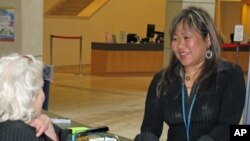
The San Francisco Public Library is a modern seven-story building on a busy street in the center of the city.
It serves thousands of patrons every day, including Bruce Sokol, an out-of-work carpenter who is staying in a homeless shelter and appreciates the services offered at the library.
"I use it as my home base," says Sokol. "I use the café downstairs and I read a lot."
Most people go to public libraries in the United States to borrow a book free of charge. However, over time, libraries have added other free services like homework help, computers with internet access and community rooms patrons can use for meetings.

More than checking out books
The San Francisco Public Library is now offering another new service specifically aimed at people like Sokol: a full-time social worker for the homeless. Sokol is one of the many jobless and homeless who find sanctuary in the library.
"This is a public space. This is where people have a right to come in, have a right to enjoy the resources here," says Raj Parekh, a psychiatrist with the San Francisco Public Health Department, and director of the city's Homeless Outreach Team.
Parekh says extending the right to use the library may come with complications. "We saw a need at the library where a lot of homeless folks, a lot mentally ill folks do come into the library, to use the library, very appropriately. But some of them also come into the library for reasons the library is not designed for."
That includes napping in quiet corners, using drugs, causing disturbances, and shaving, doing laundry or washing more than their hands in the bathroom sinks.
So library and health department officials teamed up and assigned a social worker to work with the homeless inside the library.
Parekh says the first step is to redirect homeless people to shelters and showers, "…while at the same time assisting them to hopefully get out of the homelessness. Hopefully, if they have mental illness, to get treatment through the clinics we have at the Department of Public Health."
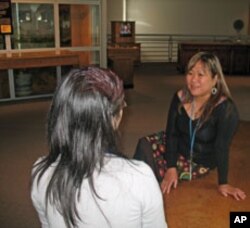
Homeless outreach
That's where social worker Leah Esguerra comes in. She's worked with the homeless in a mental health clinic. Now her territory is the library.
"My goal is to be able to link the patrons who are homeless and chronic substance abusers, mentally ill, to the appropriate services," says Esguerra.
She was assigned to the library job early last year and purposely takes a low-key approach.
"People come here to study. So when they're in their space, they have their books open in front of them I feel like it's an intrusion of their space for me to be able to talk them, even introduce that I am a social worker, even second-guessing, 'Are they homeless? Would they be offended?'"
That's an important consideration, according to Karen Strauss, the assistant chief librarian of the main branch. She says the project emphasizes that library users are not labeled.
"The library was interested in making this a welcoming safe secure inviting place for all users, and anyone is welcome and everyone is welcome, the more the better," says Strauss.
A hand up
As part of the project, four previously homeless people were hired to work part time to monitor the library and the restrooms.
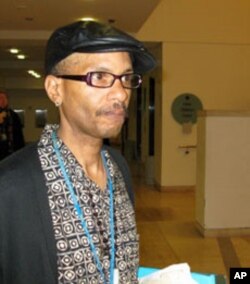
One of them is Melvin Morris, who found housing and job training through the Homeless Outreach Team. He is comfortable with another important part of his job - being a contact point for the homeless.
Morris says first you get to know them, then ask privately if they want help. "Cause the only thing they want is respect," says Morris. "You have to respect their boundaries."
Standing in the library atrium, with his clipboard and security phone, Morris radiates pride in his job and the lifestyle it's brought him.
"So now I have my own place and I pay my own rent. I like it a lot. This is the first time in my life I ever had my own place."
Changing lives
The numbers suggest the program is changing lives.
In just over a year, 250 people talked with Leah Esguerra. Thirty-five found temporary housing and 15 found a permanent place to live. Two people got jobs.
And Esquerra says she expects those numbers to go up, as word of the program spreads.