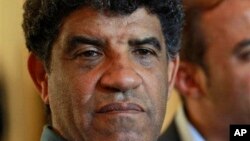
Former Libyan intelligence chief Abdullah al-Senussi, shown here Aug. 21, 2011, speaking with reporters in Tripoli, Libya.
TRIPOLI, LIBYA —
The International Criminal Court has toughened its stance toward Libya, ordering the country’s new rulers on Thursday to halt a pending trial in Tripoli of Moammar Gadhafi's former spy chief, Abdullah al-Senussi.
The ICC judges insisted that Senussi be surrendered to the Hague-based court instead to face charges of mass killings and other atrocities.
Libyans worry the move foreshadows a likely ICC demand for Libya to hand over Gadhafi’s son, Saif al-Islam. Al-Islam is being held at Zintan in northwest Libya after being captured at the end of the uprising that ousted his father from power.
Debate over where to try Senussi and other high-ranking Gaddafi officials raged even before the Gadhafi regime was toppled over a year ago. In June 2011, four months before Gadhafi fell, Saif and al-Senussi were indicted by the ICC on war crimes charges for their alleged roles in trying to stamp out the uprising.
The ICC “orders the Libyan authorities to proceed to the immediate surrender of Mr. Senussi to the court,” the ICC judges said the ruling made public Thursday. “Libya remains under obligation to comply with the surrender request."
Longstanding concerns
Lawyers at The Hague have long expressed their concern about Libya’s ability to conduct trials that can meet international legal standards. They fear prosecutions will turn into show trials.
If the Libyan government refuses to comply with the demand, ICC officials say the court will then decide whether to refer the matter to the U.N. Security Council.
Thursday’s ICC’s ruling raises the stakes in an increasingly acrimonious standoff between the international court and Libya’s government over who should prosecute relatives and aides of Gadhafi, who was killed by rebels in October, 2011.
ICC officials worry that if they fail to persuade Libya to comply, then the prestige and authority of the court will be damaged and encourage other countries to defy the court’s instructions.
Last month, the ICC pressed Libya to detail its plans for conducting fair trials of Gadhafi’s son and the former intelligence chief.
Secret hearing
The Libyans responded by bundling Saif al-Islam, unannounced, into a secret hearing in Zintan – his first court appearance since his capture – where more charges were filed against him. Al-Islam had previously been charged by Libya with war crimes.
Saif al-Islam, son of Moammar Gadhafi, makes a peace sign before meeting reporters in Tripoli, Libya, Aug. 23, 2011.
At the hearing, Libyan prosecutors also filed formal accusations in absentia against an ICC lawyer and a translator, accusing them of involvement in an alleged conspiracy over the summer to help al-Islam escape from jail.
During a June visit to Zintan, militiamen detained ICC defense lawyer Melinda Taylor and her Lebanese translator, Helene Assaf. The two were accused of spying and passing escape plans to Gadhafi’s son -- allegations that both women vehemently denied. Taylor, Assaf, and two other colleagues were released after 25 days detention.
Taylor had clashed with Libyan officials repeatedly before her detention when she argued that any Libyan trials of former Gadhafi officials would fail to meet international standards.
Libyans resist outside trials
Libya’s prosecutor-general’s office insists the country can hold fair trials of former Gadhafi aides and it has the backing of key national leaders, including Mahmoud Jibril, head of the moderate coalition that won the majority of party seats in last July’s elections.
They say the ICC is only mandated to take cases from countries that are unable or unwilling to prosecute war criminals. Libya is both willing and able to do so, they say.
Al-Senussi’s lawyer, Ben Emmerson, hailed Thursday’s ICC demand, saying the international court had "ordered an immediate halt to Libya's unseemly rush to drag Mr. al-Senussi to the gallows before the law has taken its course."
In its statement, the ICC also demanded that Emmerson be given access to his client, something Libyan authorities have blocked since al-Senussi was transferred to Libya from Mauritania last September.
Public pressure has been growing in Libya for Saif and other top regime figures to stand trial in the country and not handed over to the ICC. Former U.N. diplomat Omar Bakhet, however, warns that “trials [in Libya] could lay the seeds for future conflict and won’t help advance reconciliation.”