In Libya, Shock, Division Follow US Embassy Attack
日本首相安倍晋三12月26日在神道祭司的引领下参拜东京的靖国神社。
TRIPOLI —
The call to prayer sounded over a subdued Tripoli Thursday as residents of Libya’s capital tried to understand the killings of the U.S. ambassador and three diplomats during the storming of the American consulate in the eastern city of Benghazi.
For many Libyans, the deaths late Tuesday night were shocking enough and apologies are thrust on Americans encountered on the streets. Libyan leaders also apologized, stressed their unity with Washington and vowed to track down the killers.
But beyond the condolences and apologies was a worry – worry that the United States and western nations might give up on Libya, possibly making their struggling government even weaker.
As the news circulated among Libyan activists that the U.S. embassy was evacuating, along with private U.S. assistance groups such as the National Democratic Institute and the International Foundation for Electoral Systems, fear mixed in with the shock.
“It is very bad,” said Ahlam Ben Tabon, who works at the domestic branch of a non-governmental organization (NGO), Foundation for the Future. “The government is not in control and this is a real calamity. We need the Americans.”
Two months ago, Libyans celebrated their first elections after the fall of Moammar Gadhafi. They did so with joy mixed with relief. The elections had gone well, despite a disappointingly low turnout. Worst-case predictions that federalists in the east would derail the elections didn’t come to pass and violence was minimal. The general feeling was that Libya was on the path to stability.
Security challenges remain
But security challenges for the country have remained, including simmering ethnic disputes in the south, clashes between town-based militias and a series of assassinations of former Gadhafi military and intelligence officers. And in recent weeks, there has been a surge in violence by Islamist groups intent on ridding Libya of anything that does not fit ultra-conservative Muslim ideology. That would include Sufi mosques and shrines as well as university and school classes that mix genders.
US Ambassador J. Christopher Stevens
US Ambassador J. Christopher Stevens
Served as U.S. ambassador to Libya since May
Held two earlier postings in Libya
Previous assignments in Israel, Syria, Egypt and Saudi Arabia
Worked as an international trade lawyer before joining the Foreign Service in 1991
Taught English in Morocco as a Peace Corps volunteer from 1983 to 1985
The storming of the U.S. consulate and the killing of Ambassador Christopher Stevens has highlighted for many just how vulnerable and fragile Libya is right now.
The president of the newly installed General National Congress, Mohamed Yousef el-Magariaf, lashed out at foes wanting to impede “our democratic experiment.
“We together with the United States government are on the same side, standing in a united front in the face of these murderous outlaws,” Magariaf said.
Magariaf also promised new measures to ensure the security of foreign diplomats and residents and all efforts would be made to track down the embassy attackers.
Who carried out attack?
But neither Magariaf nor the country’s outgoing prime minister, Abdurrahim Abdulhafiz El-Keib, can agree on the identity of the attackers: remnants of the Gadhafi regime or militant Salafists.
In recent weeks, Libyan leaders have reflexively blamed former Gadhafi officials – it is easier that way. But for Ahlam Ben Tabon, there is no doubt.
“The Benghazi attack wasn’t the work of Gadhafi people; it was Salafists,” she said. “And some in the government like to confuse the issue because some of them are linked in Islamist belief with the Salafists who carried out the attack.”
She is not the only one who thinks that. Political activists attending a rally in Algiers Square in downtown Tripoli Wednesday night to protest the Benghazi attack also dismissed the talk of old regime figures being to blame. The culprits for them are also ultraconservative Muslims.
Aimen, who wouldn’t give his family name for fear of Salafist retribution, said he believed there was “a hidden hand” behind the recent surge in Muslim extremism, arguing that “Saudi and Qatar are encouraging them through their preachers and through funding.”
“Unfortunately,” he added, “they can exploit the lack of education here and the ignorance.”
The few activists at the rally to oppose what happened in Benghazi expressed their disappointment at the small turnout for the demonstration – only about 150 protested.
“I am here to express my condolences to the families of the Americans who died,” says Mohamed Asad Ellafy, a media coordinator for the Libyan youth NGO H2O. “It is a worry that the government is too weak to protect people and stop these attacks. This I hope would be a wake-up call. Libyans need to say loudly the guns have to be taken off the streets.”
Lingering resentment
But not everyone at the rally agreed with those sentiments.
A few in the crowd spoke less about the attack on the U.S. Consulate in Benghazi than a movie that was said by many to have triggered the violence.
The movie, entitled “Innocence of Muslims,” appeared to insult the Prophet Mohammed and many Muslims considered it a clear provocation that deserved a response.
“The Americans insulted us and our Prophet,” said a bearded young man at the rally who gave his name as Abu Suleiman. “The movie was disgusting.”
One of the major differences between Arab Spring in Egypt and Libya is that in Egypt, pro-democracy groups can get their supporters out in large numbers to make their feelings known. In Libya, such groups do not have the weight of numbers and ordinary Libyans increasingly are too scared to protest against the militias and the Salafists.
Fowzi Omaar, an adviser to Dr. Mahmoud Jibril, who led a centrist alliance of groups to victory in the recent elections, said, “There is real disappointment that the young are not protesting on the streets at what has been going on in recent weeks. They should be out there every night to protect the revolution.”
The disappointment was written on the faces on those at Wednesday night’s rally.
“Most of our people are not extremists,” says 58-year-old Annaily al-Housh, a physician who says he was tortured for five days during the rebellion to unseat Gadhafi because of his opposition to the ousted dictator. “We want to be part of the world.”
VOA's Susan Yackee talks to Jamie Dettmer about his observations from Tripoli. Dettmer has been in and out of Libya for the past six months:
Photo Gallery: Anti-US Protests in Middle East
US Diplomatic Posts Attacked in Middle East
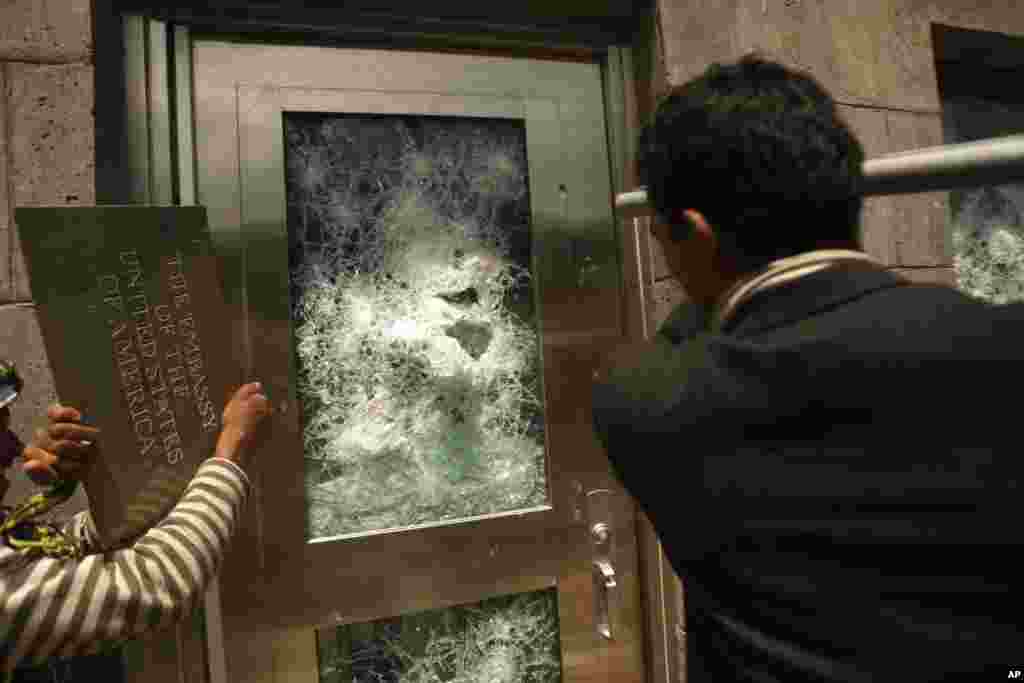
1/14Yemeni protestors break a door of the U.S. Embassy during a protest about a film ridiculing Islam's Prophet Mohammed, Sana'a, Yemen, September 13, 2012.
Demonstrators angered over a film mocking Islam attacked U.S. embassies in Egypt and Yemen. The U.S ambassador to Libya was killed during demonstrations at the U.S. consulate in Benghazi, Libya.
Show moreShow less
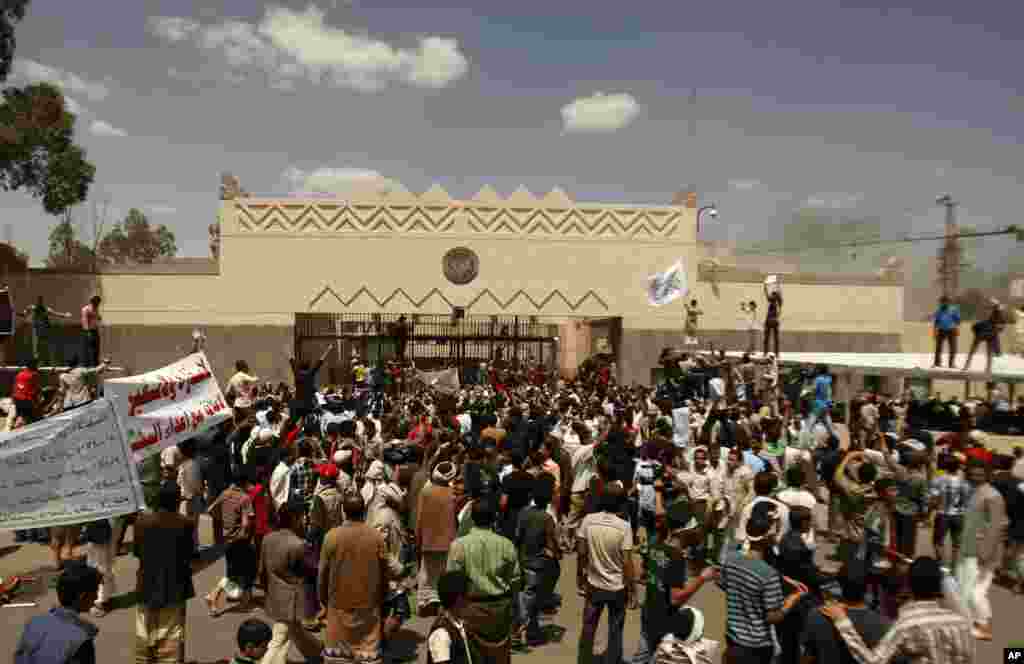
2/14Yemenis protest in front of the U.S. Embassy during a protest about a film ridiculing Islam's Prophet Mohammed, Sana'a, September 13, 2012.
Demonstrators angered over a film mocking Islam attacked U.S. embassies in Egypt and Yemen. The U.S ambassador to Libya was killed during demonstrations at the U.S. consulate in Benghazi, Libya.
Show moreShow less
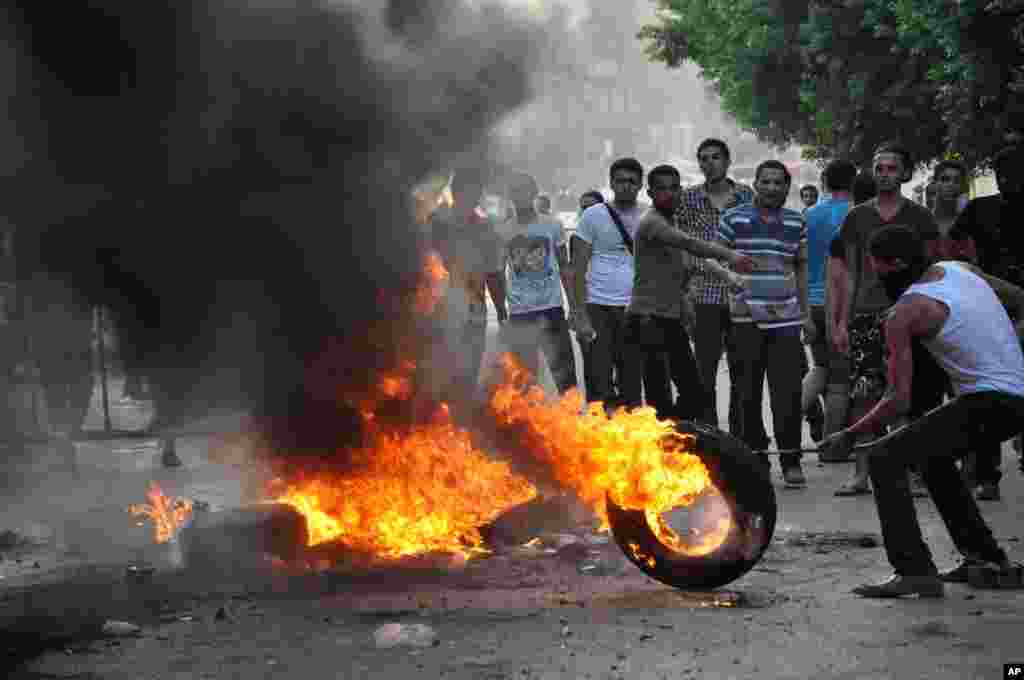
3/14Egyptian protesters burn tires as they clash with riot police outside the U.S. embassy in Cairo, Egypt, September 13, 2012.
Demonstrators angered over a film mocking Islam attacked U.S. embassies in Egypt and Yemen. The U.S ambassador to Libya was killed during demonstrations at the U.S. consulate in Benghazi, Libya.
Show moreShow less
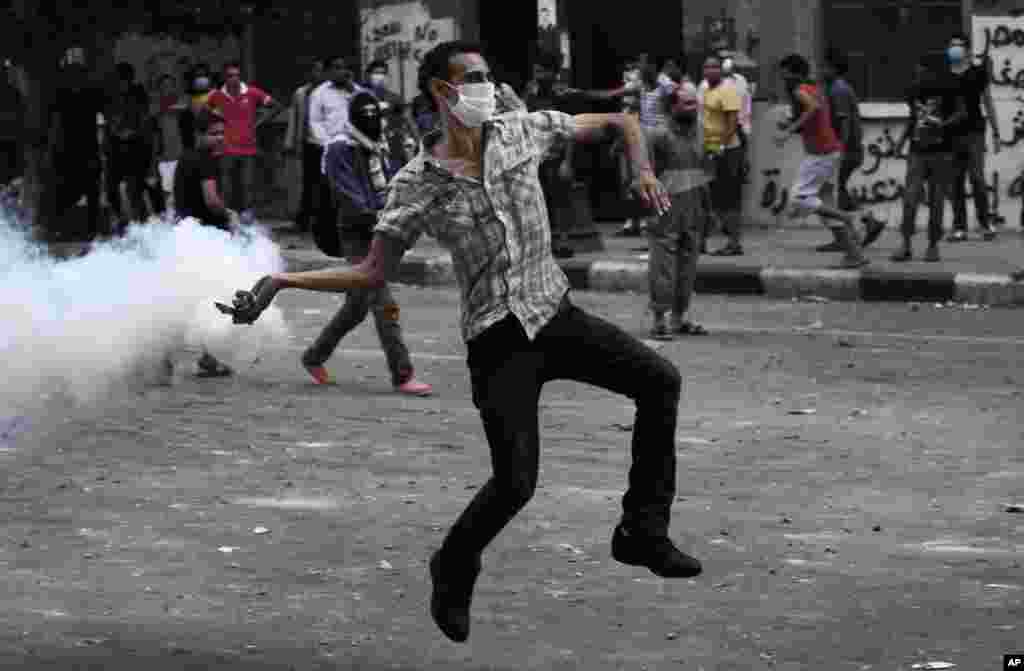
4/14An Egyptian protester throws back a tear gas canister toward riot police outside the U.S. embassy in Cairo, September 13, 2012.
Demonstrators angered over a film mocking Islam attacked U.S. embassies in Egypt and Yemen. The U.S ambassador to Libya was killed during demonstrations at the U.S. consulate in Benghazi, Libya.
Show moreShow less
5/14A policeman stands in front of a police car set on fire by protesters in front of the U.S. embassy in Cairo, Egypt, during clashes between protesters and police, September 13, 2012.
Demonstrators angered over a film mocking Islam attacked U.S. embassies in Egypt and Yemen. The U.S ambassador to Libya was killed during demonstrations at the U.S. consulate in Benghazi, Libya.
Show moreShow less
6/14White House staff are pictured after they lowered the U.S. flag to half staff on the roof of the White House in Washington, September 12, 2012, following the death of U.S. Ambassador to Libya, Chris Stevens.
Demonstrators angered over a film mocking Islam attacked U.S. embassies in Egypt and Yemen. The U.S ambassador to Libya was killed during demonstrations at the U.S. consulate in Benghazi, Libya.
Show moreShow less
7/14President Barack Obama delivers a statement with Secretary of State Hillary Clinton from the Rose Garden of the White House in Washington, September 12, 2012
Demonstrators angered over a film mocking Islam attacked U.S. embassies in Egypt and Yemen. The U.S ambassador to Libya was killed during demonstrations at the U.S. consulate in Benghazi, Libya.
Show moreShow less
8/14A burnt car is parked at the U.S. consulate, which was attacked and set on fire by gunmen, in Benghazi, Libya, September 12, 2012.
Demonstrators angered over a film mocking Islam attacked U.S. embassies in Egypt and Yemen. The U.S ambassador to Libya was killed during demonstrations at the U.S. consulate in Benghazi, Libya.
Show moreShow less
9/14Typhoon survivor Manolito Pacurib stands inside his damaged home near a shipping vessel that remains grounded after being washed ashore during Typhoon Haiyan, in Tacloban, Philippines, Dec. 23, 2013.
Demonstrators angered over a film mocking Islam attacked U.S. embassies in Egypt and Yemen. The U.S ambassador to Libya was killed during demonstrations at the U.S. consulate in Benghazi, Libya.
Show moreShow less
10/14An interior view of the damage at the U.S. consulate, which was attacked and set on fire by gunmen yesterday, in Benghazi, Libya, September 12, 2012.
Demonstrators angered over a film mocking Islam attacked U.S. embassies in Egypt and Yemen. The U.S ambassador to Libya was killed during demonstrations at the U.S. consulate in Benghazi, Libya.
Show moreShow less
11/14Christopher Stevens, the U.S. ambassador to Libya, was killed along with three of his staff on September 11, 2012 during a demonstration at the U.S. consulate in Benghazi. This photo was taken at his home in Tripoli, June 28, 2012.
Demonstrators angered over a film mocking Islam attacked U.S. embassies in Egypt and Yemen. The U.S ambassador to Libya was killed during demonstrations at the U.S. consulate in Benghazi, Libya.
Show moreShow less
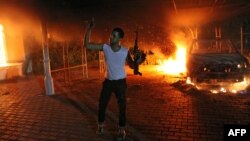
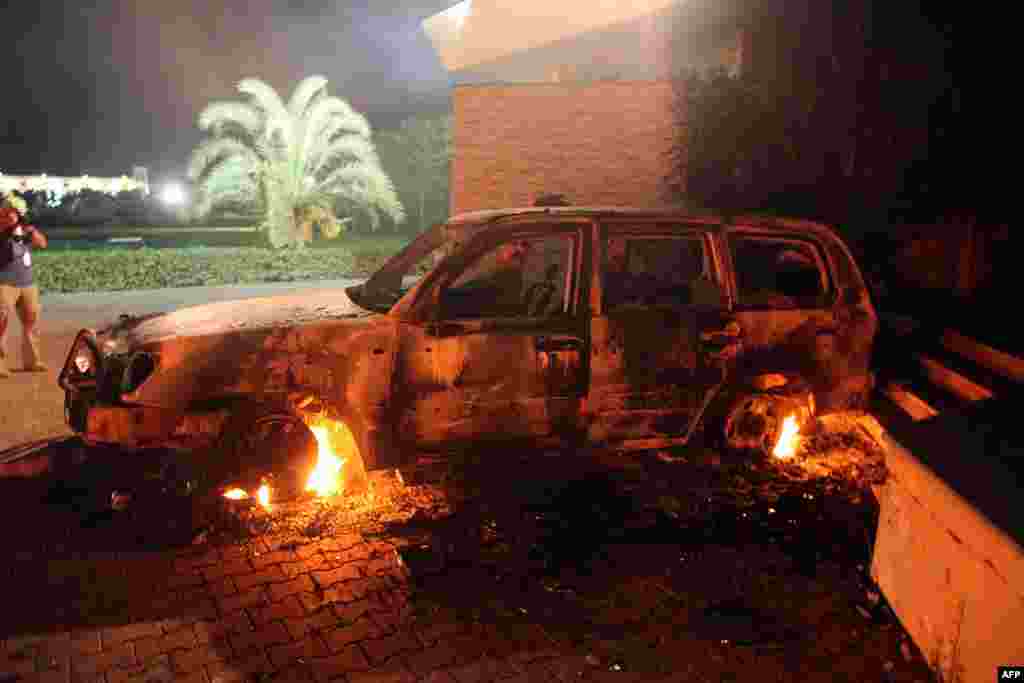
12/14A vehicle sits smoldering in flames after being set on fire inside the US consulate compound in Benghazi late on September 11, 2012.
Demonstrators angered over a film mocking Islam attacked U.S. embassies in Egypt and Yemen. The U.S ambassador to Libya was killed during demonstrations at the U.S. consulate in Benghazi, Libya.
Show moreShow less
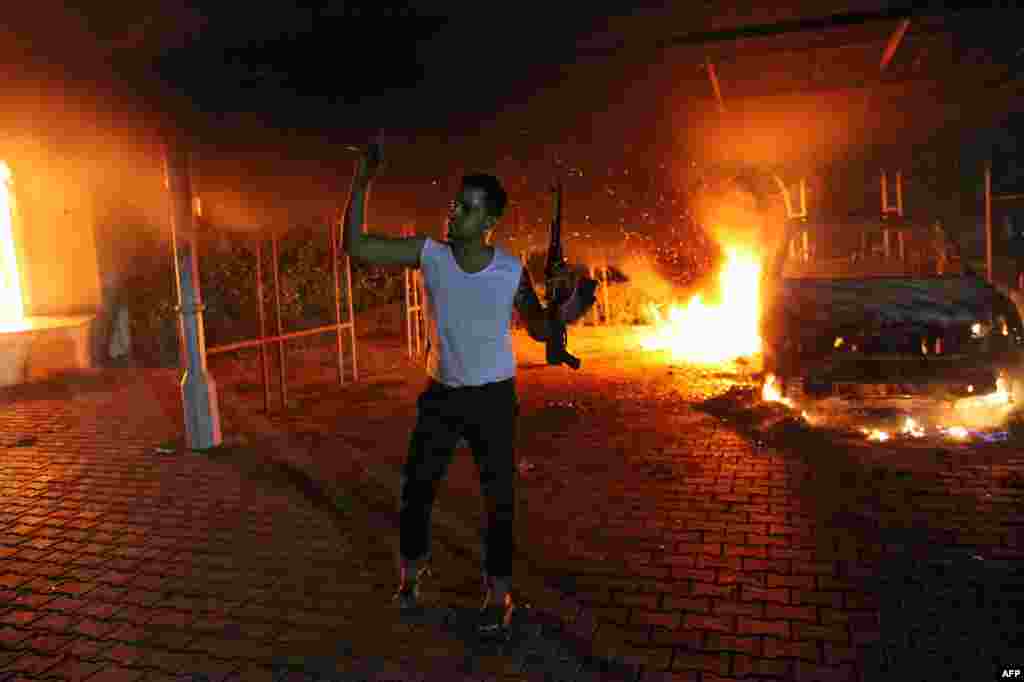
13/14An armed man waves his rifle as buildings and cars are engulfed in flames after being set on fire inside the U.S. consulate compound in Benghazi, Libya, late on September 11, 2012.
Demonstrators angered over a film mocking Islam attacked U.S. embassies in Egypt and Yemen. The U.S ambassador to Libya was killed during demonstrations at the U.S. consulate in Benghazi, Libya.
Show moreShow less
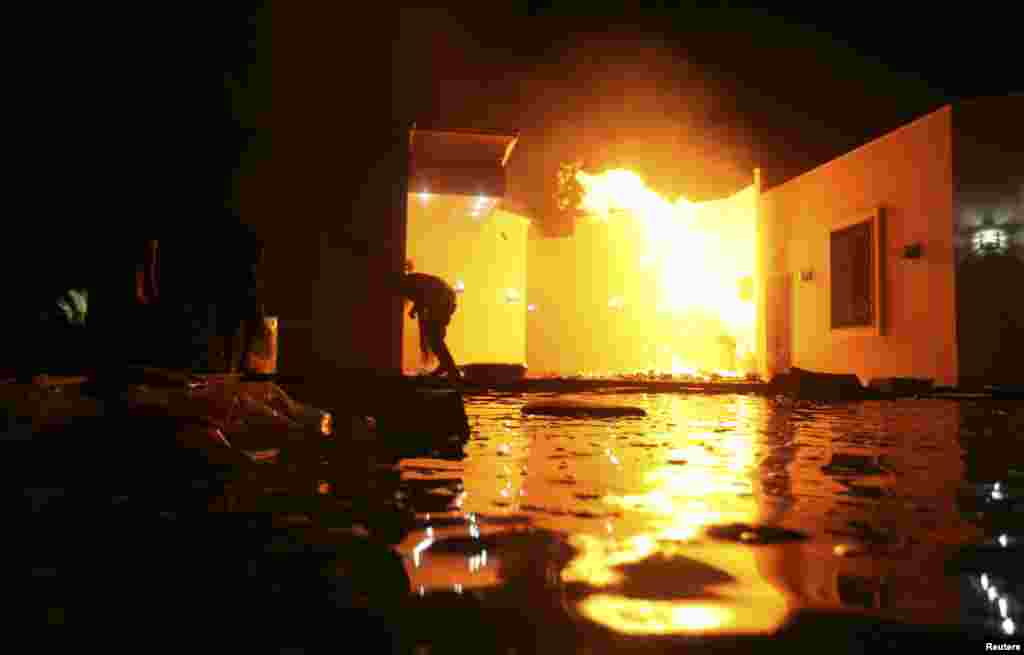
14/14U.S. Consulate in Benghazi in flames during protest, September 11, 2012
Demonstrators angered over a film mocking Islam attacked U.S. embassies in Egypt and Yemen. The U.S ambassador to Libya was killed during demonstrations at the U.S. consulate in Benghazi, Libya.