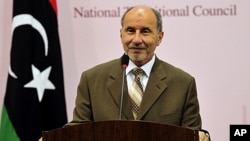
Libyan military prosecutors told the country's wartime rebel leader not to leave the country on Tuesday after questioning him over the killing of a top field commander during last year's conflict, a military prosecution official said.
Mustafa Abdel Jalil led the National Transitional Council (NTC) formed after a revolt against Muammar Gaddafi's four-decade rule broke out in the eastern city of Benghazi.
Colonel Abdel Fattah Younes was Gaddafi's interior minister before he defected and joined the rebellion. Gunmen killed Younes in Benghazi in July 2011.
``After listening to the testimony of Mustafa Abdel Jalil, the prosecution has ordered him not to leave the country,'' said the official, who declined to be named.
Abdel Jalil was interrogated in the town of Al-Marj, 100 km east of Benghazi, the prosecution official said. He refused to elaborate on the interrogation and did not say if Abdel Jalil has been accused or charged with any crime.
He said wartime rebel Prime Minister Mahmoud Jibril was also called in for questioning. Younes's death highlighted ideological splits within the rebel movement that endure in the government formed after Gaddafi's overthrow.
Disputes and power struggles between the factions that united to oust Gaddafi are making it harder for the oil-rich desert country to return to stability and cause chronic confusion over policy.
Younes was welcomed by some into the rebellion and spurned by others, who suspected he may harbour lingering loyalty to the Gaddafi clan and opposed giving him a commanding position in the insurgency.
Younes, who was one of the group involved in the 1969 coup that brought Gaddafi to power, vied with another rebel figure for command of the anti-Gaddafi forces and, at one point, both men claimed to be their leader.
Abdel Jalil, 60, was a judge and justice minister during the Gaddafi era. He resigned from Gaddafi's government in February 2011, at the start of the uprising.
Eleven men have been charged in connection with Younes's murder, including a former deputy premier of the NTC, but only one has been arrested.
In November 2011, the NTC's chief military prosecutor Yussef al-Aseifr named its former deputy prime minister Ali el-Essawi as the main suspect in the killing of Younes.
A year later, Essawi was charged with abuse of his authority and, along with nine other men, assisting in the abduction of Younes before his death. Another man, Salem al-Mansouri, was charged with the actual killing.
Only Mansouri is in custody. A trial has been set for Feb. 20.
Mustafa Abdel Jalil led the National Transitional Council (NTC) formed after a revolt against Muammar Gaddafi's four-decade rule broke out in the eastern city of Benghazi.
Colonel Abdel Fattah Younes was Gaddafi's interior minister before he defected and joined the rebellion. Gunmen killed Younes in Benghazi in July 2011.
``After listening to the testimony of Mustafa Abdel Jalil, the prosecution has ordered him not to leave the country,'' said the official, who declined to be named.
Abdel Jalil was interrogated in the town of Al-Marj, 100 km east of Benghazi, the prosecution official said. He refused to elaborate on the interrogation and did not say if Abdel Jalil has been accused or charged with any crime.
He said wartime rebel Prime Minister Mahmoud Jibril was also called in for questioning. Younes's death highlighted ideological splits within the rebel movement that endure in the government formed after Gaddafi's overthrow.
Disputes and power struggles between the factions that united to oust Gaddafi are making it harder for the oil-rich desert country to return to stability and cause chronic confusion over policy.
Younes was welcomed by some into the rebellion and spurned by others, who suspected he may harbour lingering loyalty to the Gaddafi clan and opposed giving him a commanding position in the insurgency.
Younes, who was one of the group involved in the 1969 coup that brought Gaddafi to power, vied with another rebel figure for command of the anti-Gaddafi forces and, at one point, both men claimed to be their leader.
Abdel Jalil, 60, was a judge and justice minister during the Gaddafi era. He resigned from Gaddafi's government in February 2011, at the start of the uprising.
Eleven men have been charged in connection with Younes's murder, including a former deputy premier of the NTC, but only one has been arrested.
In November 2011, the NTC's chief military prosecutor Yussef al-Aseifr named its former deputy prime minister Ali el-Essawi as the main suspect in the killing of Younes.
A year later, Essawi was charged with abuse of his authority and, along with nine other men, assisting in the abduction of Younes before his death. Another man, Salem al-Mansouri, was charged with the actual killing.
Only Mansouri is in custody. A trial has been set for Feb. 20.