


Moammar Gadhafi’s Libya was known for cultivating support in Africa and tangling with Europe, the United States and moderate Arab governments. But now there appears to be a big foreign-policy shift toward the West in the air.
Two political snapshots capture the new directions for the foreign relations of Libya, holder of the largest oil reserves in
Africa. Last week, South African President Jacob Zuma, speaking for the African Union, refused to recognize Libya’s rebels as the new
government of Libya.
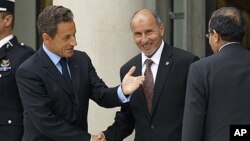
This week, Mustafa Abdel Jalil, chairman of Libya’s transitional authority, was feted in Paris at a Libya meeting by the leaders of
France and Britain and U.S. Secretary of State Hillary Clinton.
On the streets of Tripoli, the view is that Libya will turn away from African states south of the Sahara and cultivate relations north of the Mediterranean.
"We can’t flee Africa. We are part of the continent, but we want the U.S. and Europe to help us," said Abdurazeg Akhmeda Jamour, a rebel leader:
Moammar Gadhafi, Libya’s fugitive leader, spent billions of dollars to cultivate African leaders. A decade ago, he launched the Africa Union. Two years ago, he styled himself Africa’s “King of Kings.” He called for the formation of the United States of Africa.
Peter Cole, a Libya expert, says Mr. Gadhafi’s generosity toward sub-Saharan leaders explains the African Union’s reluctance to follow
the lead of the 75 nations worldwide that have extended diplomatic recognition to Libya’s National Transitional Council.
“[They are] very, very tiny countries - Libyan spending in there could be a significant part of GDP. So there is a lot of genuine fear among AU members that they will lose out,” Cole said.
Libyans are watching who is slow to extend diplomatic recognition to the rebels. Russia, Algeria and the African Union - all
friends of Mr. Gadhafi - have been the laggards.
Rafa Rejeibi, who once taught Arabic in the United States, pauses from celebrating the rebels' seizure of Tripoli to offer an explanation.
“Libyans now are a little bit sensitive to the way the African countries had reacted to the Libyan revolution. We were counting more
on them, and really we saw the opposite,” Rejeibi said.
Instead, Rejeibi and others say, Libyans now want to open up to the wider world.
“Libyan people are just very thirsty and hungry to open up to all nations and cultures. It is not just to the U.S. and to France, as
people say, because they were pioneers to take action to protect Libya against Gadhafi militias,” Rejeibi said.
During Mr. Gadhafi's era, Libya’s foreign policy included giving weapons to European terrorist groups and blowing up two passenger jets - one American and one French. Now Libyans stress that Mr. Gadhafi’s hostility toward the West is not shared by modern Libyans. Amar, a rebel unit fighter, speaks at a victory celebration.
“The people of Libya were not an enemy of America [loud bangs] Gadhafi was an enemy,” Amar said.
In a neighborhood near a walled compound that once served as the nerve center of Mr. Gadhafi's rule, Ali Azoz is the imam of a local mosque. He also leads his neighborhood’s underground resistance organization.
"People don’t have any problems with America or any other country. The whole world should know that Gadhafi’s character only represents himself," he said.
Inside the compound, Nale, a 20-year-old dentistry student, is touring with her father, Khalid, an engineer. Nale says she wants to discover the world. She resents Gadhafi’s past restrictions on studying English.
"We are not allowed to speak English, to study English in schools. And his (Gadhafi's) son goes to London and studies in the best unis [universities.] And we are not allowed to do that. It’s so weird," Nale said.
Libyans caution that they want future relations with the West to built on the levels of mutual respect. They know their 20th-century history: an Italian colony for three decades, administered by Britain for a decade, home to a massive American air base until 1970, a close trading partner for the Soviet Union during the Gadhafi era. But Libya has changed, and Libyans have changed.
In an upper middle class home, Fatma Ghobtan says Libyans are fast embracing the future.
“We don’t want the back history - [such as his ties with] Russia. We want new faces, we want new people, we want new education. We want everything new. It’s 2011. Everyone with a computer, with a mobile. Everything has changed,” Ghobtan said.
Agreement comes from Milad Mohammed Arier, a 30-year-old fire extinguisher salesman, who is relaxing with neighbors on a street corner on a hot evening.
“We are so near to Europe. Even our mentality is so open, because we are reading. Technology. Internet access. Mobile phones, they are coming, and they are changing everything. Even now if you are working in Tripoli, you will see the difference in the knowledge between the old men and the new guys, between 20 years and 40 years,” Arier said.
With half of Libya’s population under 15 years of age, the demographic momentum seems to be on the side of big changes in how Libya relates to the world.
Libya Turns From Africa to the West
- By James Brooke