


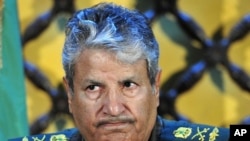
Libya's rebel leadership council says its top military commander, Abdel Fattah Younes, and two of his aides have been shot dead by unknown assailants.
Transitional National Council head Mustafa Abdel Jalil said Thursday that Younes and his aides - both colonels - were killed before arriving for questioning at an opposition judicial committee hearing regarding a "military matter."
He said the head of the armed cell that killed the men had been arrested.
Jalil never clearly indicated who he thought was behind the attack. But he called on rebel forces to ignore "efforts to break our unity" by leader Moammar Gadhafi's government. He also warned of "armed criminal gangs" in rebel-held cities, saying they needed to join the fight against Gadhafi or risk being arrested by security forces.
Hours earlier, the rebels said they had detained Younes on suspicion his family may still have ties to Gadhafi's inner circle.
Younes had been the Libyan leader's interior minister and one of his closest confidants before unexpectedly defecting to the opposition early in the uprising, which began in February. He was part of the group involved in the 1969 coup that brought Gadhafi to power.
Jalil called Younes "one of the heroes of the February 17 Revolution." He said the rebels would observe three days of mourning following his death and vowed his forces would continue their fight to overthrow Gadhafi's government.
Earlier Thursday, the Libyan opposition said it seized the western town of Ghezaia after launching a new offensive in the region.
Medical officials said at least two rebels were killed in fighting with loyalist forces in the area, which is near the Tunisian border. Gadhafi's troops had used the town as a base to launch attacks on rebels in the nearby mountains.
The fighting comes a day after Jalil said the council's offer for Gadhafi to remain in the country if he cedes power had expired. Libyan Prime Minister Al-Baghdadi al-Mahmoudi has said Gadhafi's departure is not up for discussion.
The Libyan government also condemned Britain's decision to recognize the opposition council and expel all of Libya's diplomats, calling the moves "illegal and irresponsible."
British Foreign Secretary William Hague said Wednesday the decision is based on the opposition's increasing legitimacy, competency and success in reaching out to Libyans across the country.
Hague said the opposition council is working toward a more open and democratic Libya, which he said is in "stark contrast" to Gadhafi, whose "brutality" against the Libyan people has stripped him of legitimacy.
Some information for this report was provided by AP and Reuters.