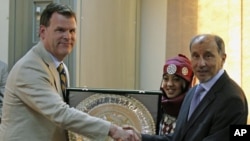
Libyan rebels are depending heavily on international help in their drive to topple leader Moammar Gadhafi. Some nations, like France and Britain, stepped in early to back the opposition. Turkey has just declared its support, while others remain undecided. The rebels say they will remember who did what - and when they did it.
Canadian Foreign Minister John Baird strides to the podium. His cotton suit is as befitting the heat of a Benghazi afternoon as his rebel lapel pin is of the occasion.
"I'm very pleased to be here and to lend our strong support to you and your fellow countrymen for your struggle in this revolution," said Baird. "Canada was an early supporter of the call for the United Nations to bring in sanctions."
Baird is among the latest in a string of foreign envoys to make an appearance in the rebel's defacto capital, and he used his visit to stress Ottawa's solidarity with the anti-Gadhafi cause.
Jalal elGalal, a spokesman for the Transitional National Council [TNC], is among those thankful for the support of Canada, whose General Charles Bouchard is leading the U.N.-backed NATO mission to protect civilians in Libya.
He is also grateful to the dozen countries that have granted the TNC diplomatic recognition. But gratitude has its limits.
"Symbolically, it's all very well. But what we need now, we need it to translate into something practical," said elGalal. "Gadhafi's playing for time. And this time is to make sure discontent grows in the liberated area. And this will happen if the lack of the finances is prolonged more than it already has."
From the money needed to pay salaries, to the training needed to ensure a peaceful transition, rebel officials say more is needed now.
Interior Minister Ahmed al Darrat said many envoys, in particular from the United States, Britain and France, have promised training and equipment for the police force he oversees. Unfortunately, he added, nothing has happened yet. He is hopeful French help will be coming soon.
The motives for support are many. After a slow start in showing solidarity in the early days of the "Arab Awakening," many in the West feel they want to be on what they view as the right side of history. And if Gadhafi does leave the scene, they would rather not repeat the chaos of post-U.S-invasion Iraq, which was widely blamed on a lack of planning. The prospect of a stable, friendly, oil-producing friend in North Africa also has its appeal.
For some of the rebels, the 'why' of foreign intervention almost does not matter. Spokesman elGalal points to Qatar, the first Arab nation to recognize the rebels. The Gulf state supports the NATO mission, funds rebel media, and recently gave the TNC $100 million in cash.
"The Qataris took the best approach, which is 'advance today, win the hearts and minds, and later on you'll get your rewards.' It's a philosophy that is working [and] that is very smart," said elGalal.
But not all nations are ready to abandon support for Libya's long-time leader, at least not yet. Russia and China, for their own reasons, have argued against foreign intervention in other countries' affairs. But China also has hosted members of the Libyan government and the rebel movement.
Moscow and Beijing are joined by the Arab League in other reservations, in particular over what they see as mission creep: NATO moving from protection of civilians to apparent regime change.
Such qualified approaches have earned the contempt of some in the rebel camp. NATO member Germany abstained from voting on the U.N. resolution on the alliance's intervention, something rebel military spokesman Colonel Ahmed Omar Bani said calls for shame.
"After liberation, paradise will appear in North Africa," he said. "This paradise is Libya. No one will be in this paradise if he didn't support us now - that's all."
Such score settling is not shared by everyone in the opposition, and perhaps reflects only a passing frustration. But it just could be a sign of the kind of intemperate policies many hope a future Libya will avoid, and what help now could prevent.
Libyan Rebels Keeping Track of Who's Helping Now