


The emerging governing authority in Libya is appealing for financial help from world powers, warning there will be grave destabilization in Libya if it cannot pay people's salaries and provide services in the post-Gadhafi era.
Italian pledge
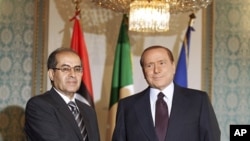
Mahmoud Jibril of Libya's Transitional National Council spoke as he received Italy's pledge to unfreeze about $500 million held in Italian banks.
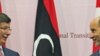
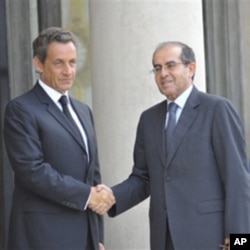
Jibril met in Milan with Italian Prime Minister Silvio Berlusconi, one day after talks with French President Nicolas Sarkozy. Jibril is on a mission to secure the release of billions of dollars in frozen Libyan assets.
The Libyan opposition envoy said he is telling friendly nations that the biggest destabilization factor in the coming weeks will be for the TNC not to be able to deliver salaries that have gone unpaid for months.
Istanbul meeting
Diplomats from more than 30 nations opened a meeting in Istanbul Thursday to discuss how to support the Libyan opposition in a post-Gadhafi era. Turkish Foreign Minister Ahmet Davutoglu told the Libya Contact Group it is time to get money to the TNC, and he appealed for action at the United Nations.
The U.N. Security Council is preparing to vote on a draft resolution that would unfreeze about $1.5 billion in Libyan assets for urgent humanitarian needs.
The United States introduced the draft resolution late Wednesday. It proposes releasing up to $500 million for international humanitarian organizations and to help fund a U.N. humanitarian appeal. Another $500 million would be used for the purchase of fuel for electricity, water plants and hospitals, and the rest for the provision of social services, including education, health care, food subsidies and other humanitarian needs. A vote is expected Thursday or Friday.
Libya's priorities
Speaking in Italy, Jibril listed some of the priorities for the TNC in next few weeks. They include establishing order and stability, starting transitional justice, and starting the early steps of building a national army that requires collecting weapons from the streets. He said the Council needs to prepare for the school year, which should start next month and provide urgent care for the wounded, both in Libya and in hospitals in other countries. He said Libya needs to repair its power stations and other infrastructure destroyed in fighting with pro-Gadhafi forces. But he said these priorities cannot be carried out without the financial means to do so.
The African Union also is due to discuss Libyan issues Thursday in an attempt to regain a role for its political roadmap. The AU, which tried to mediate the Libyan conflict, has yet to recognize the rebels.