News / USA

    Little Hope for Improved US-Russia Relations, Analysts Say

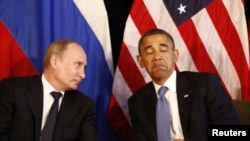
    FILE - U.S. President Barack Obama and Russian President Vladimir Putin in Los Cabos, Mexico, June 18, 2012.
    FILE - U.S. President Barack Obama and Russian President Vladimir Putin in Los Cabos, Mexico, June 18, 2012.

    Recent statements at the United Nations by President Barack Obama and Russian Foreign Minister Sergei Lavrov indicated things are not well between Washington and Moscow.

    President Obama said the international community must urgently address what he called “Russian aggression in Europe” -- a reference to Moscow’s annexation of Crimea and support for Russian separatists in eastern Ukraine, which Moscow denies it is providing. Obama compared Russia’s moves in Ukraine to two other pressing international problems: the outbreak of the Ebola virus and what he called “the brutality of terrorists in Syria and Iraq.”

    For his part, Lavrov accused the United States of pursuing an “arrogant” policy in Ukraine and attempting to  -- as he put it -- “distort the truth” about what is happening there.

    John Parker, Russia expert at the National Defense University, said relations between Washington and Moscow are at their lowest point in decades.

    “The worst they’ve been for the last 30 to 35 years. We have to go back to the period right after the Soviet invasion of Afghanistan in late 1979 and also the Soviet shoot-down of the Korean airliner in 1983 to find a period where relations have been so bad,” said Parker.

    This wasn’t the case at the beginning of the Obama administration, when the so-called “reset” in relations set a positive tone, culminating in a major strategic arms control treaty reducing the number of long-range nuclear weapons.

    Other examples of cooperation included Moscow’s tougher stance on Iran over its alleged nuclear weapons policy. And Moscow allowing American forces to transit through Russia in and out of Afghanistan -- an important step as U.S. combat troops wind down their presence in that country.

    Analysts said during the past few years, however, relations have deteriorated.

    One reason is Russia’s unwavering support for Syria’s leader Bashar al-Assad. Another is Moscow’s decision to grant former U.S. intelligence contractor Edward Snowden a three-year residency permit. And finally, Russia’s actions in Ukraine, which have triggered economic sanctions from the United States and the European Union.

    Cooperation possible

    Stephen Jones, a Russia expert at Mount Holyoke College, said despite the deteriorating relationship, the two sides could cooperate. For example, he pointed to the struggle against the so-called Islamic State militants in Syria and Iraq.

    “Here is somewhere where clearly Russia and the United States have common interests in trying to prevent the Islamic State’s spread into other regions,” he said. “Russia must be concerned about this, and what might happen in Central Asia with the rise of this sort of Islamic fundamentalism."

    But Matthew Rojansky, an analysts with the Wilson Center, sees little cooperation on that front.

    “The whole premise of [Russian President Vladimir] Putin’s foreign policy is he doesn’t follow anyone, much less America,” he said.

    Looking ahead, many experts, including Parker, said the relationship between Washington and Moscow will not change in the next few years.

    “Whoever is the next U.S. president is still going to have a lot of problems in dealing with Russia, and likewise Russia with the U.S.,” he said. “So I actually see a fairly prolonged cold warish period ahead of us that is going to extend deep into certainly the first term of whoever follows President Obama in the White House,” said Parker. “And on the other side, of course, there is no sign that Putin is ever going to leave the Kremlin. So on that side, it’s not going to change. Putin is not going to change his political spots.”

    Analysts also said there is so much distrust between the two sides that it would prevent any kind of positive movement in the relationship.



    Andre de Nesnera

    Andre de Nesnera is senior analyst at the Voice of America, where he has reported on international affairs for more than three decades. Now serving in Washington D.C., he was previously senior European correspondent based in London, established VOA’s Geneva bureau in 1984 and in 1989 was the first VOA correspondent permanently accredited in the Soviet Union.

    You May Like

    US Survey: Nearly Half of Americans Are Angrier at Current Events

    Overall, NBC News/Survey Monkey/Esquire online poll released Sunday said that 49 percent of Americans found themselves feeling angrier about the news in 2015

    Tanzania Public Officials Sign Integrity Document 

    Newly appointed permanent secretaries sign 'beefed up' integrity commitment document as part of move to ensure seriousness towards rooting out graft and injecting accountability, according to government spokesman

    Bangladesh Blogger Killing Verdict Fails to Satisfy Community

    Verdict in which 2 students have been sentenced to death and 6 others to prison for role in hacking to death of atheist blogger has largely been rejected by relatives, community

    This forum has been closed.
    Comment Sorting
    Comments
         
    by: Gennady from: Russia, Volga Region
    October 09, 2014 5:21 AM
    I wonder why Americans should bother about future relations with some ‘regional and secondary power’ like Russia according to the terminology being used by Mr Obama.

    Mr Parker’s saying: “Whoever is the next U.S. president is still going to have a lot of problems in dealing with Russia…” makes us, Russians, laugh.
    Dear Mr Parker, you have forgotten to mention “…after President Obama has deliberately created them".
    For years of his Presidency President Obama of the USA humiliated , lectured Russia, ignored its interests and concerns, did not spare his efforts and did not lose his time in bringing bilateral relations and trust between the USA and Russia to record lows after the WWII.
    It will take ages to clean up the mess in the bilateral relations between the USA and Russia that Obama’s Presidency has created.
    I bet that under the next democratic US President bilateral relations between the USA and Russia will further detiorate and will hit new lows.
    In Response

    by: Whatever...
    October 09, 2014 6:22 PM
    Good thing not many need King Putins advice, the world should set him and his gang of criminals adrift, sooner the better. Europe and the civil world needs nothing from him. Absolute power corrupts absolutely. Never fails...

    by: ditdahdit from: KS
    October 08, 2014 11:58 PM
    As a child of the '50s I remember the constant, strident propaganda from both the US and the USSR that seemed to be escalating toward another world war. Imagine my surprise when in the '90s it all just went away and we and the Soviets were partners on many projects and initiatives. And one man has wrecked all that? Unbelievable.

    by: Timothy D. Naegele from: Malibu, CA
    October 08, 2014 8:13 PM
    Things will not be well between the United States and Russia until Putin is long gone, and all Russian troops and their so-called "separatist" surrogates are removed from Crimea and Ukraine.

    Putin's days are numbered.

    See http://naegeleblog.wordpress.com/2010/02/09/russias-putin-is-a-killer/#comment-5521 (“U.S. Military Chief Compares Putin’s Ukraine Move to Stalin’s Invasion of Poland”)

    Featured Videos

    Your JavaScript is turned off or you have an old version of Adobe's Flash Player. Get the latest Flash player.
    Iraqi Forces Rescue Civilians Trapped by IS Extremists in Ramadii
    X
    Sharon Behn
    December 31, 2015 12:52 AM
    The Iraqi Security Forces are starting to evacuate civilians who had been trapped and used as human shields by Islamic extremists in Ramadi. Humanitarian organizations tell VOA’s Sharon Behn that explosives litter the streets, and those escaping have nothing but the clothes on their backs.
    Video

    Video Iraqi Forces Rescue Civilians Trapped by IS Extremists in Ramadi

    The Iraqi Security Forces are starting to evacuate civilians who had been trapped and used as human shields by Islamic extremists in Ramadi. Humanitarian organizations tell VOA’s Sharon Behn that explosives litter the streets, and those escaping have nothing but the clothes on their backs.
    Video

    Video Groups Face Major Hurdles in Syria Talks

    As the United Nations prepares to launch talks on a political transition in Syria, some key questions remain -- including the future role of Syrian President Bashar al-Assad and the ability of Syria's moderate opposition to function as a cohesive unit. There are also questions about Syria's commitment to negotiations, after an airstrike killed the head of a rebel group that took part in a recent opposition meeting. VOA State Department correspondent Pam Dockins has the story.
    Video

    Video Self-Driving Robots May Someday Handle Package Deliveries

    Someday, there may be no such thing as a deliveryman. A small robot that can drive itself on sidewalks to deliver packages is going to be tried out in the coming months in London and in some U.S. cities VOA’s Deborah Block reports.
    Video

    Video Many Americans Left Their Mark on 2015 With Kindness, Generosity, Dedication

    2015 has had perhaps more than its share of tragedy, but there were also many acts of kindness and generosity. VOA was fortunate enough to meet a few people who are giving back to their communities. Here are the highlights.
    Video

    Video Europe’s Migrant Challenge Expected to Continue Into 2016

    Europe in 2015 faced its most severe migration crisis in centuries as an estimated one million people, mostly Muslims, fled war in Syria and poverty in other countries of the Middle East and Africa for western European nations. With another three million people expected in 2016, the mass migration has raised questions about the future of Europe. VOA Europe Correspondent Luis Ramirez reports.
    Video

    Video Goat Mowing -- A New Way to Eliminate Unwanted Plants

    Washington’s historic Congressional Cemetery has adopted a new method of weeding – which is both cost-effective and environmentally sensitive. The new workforce does not care about salaries, benefits or holidays. And it provides a sustainable way of eliminating weeds, as well as adding fertilization as a by-product. VOA’s Yiyi Yang and Joseph Mok give us a closer look. Lin Yang narrates their report.
    Video

    Video China’s Migrant Workers Face 'Double Whammy' as Economy Slows

    2015 was a tough year for the Chinese economy, which saw its slowest growth in nearly 25 years. Next year looks much the same. The world’s second largest economy has long relied heavily on its massive workforce, and for the country’s more than 250 million migrant workers, the uncertainty is growing. VOA’s Bill Ide has more from Beijing.
    Video

    Video World Action Needed to Prevent Widespread Antibiotic Resistance

    Since the discovery of penicillin in 1928, we have used antibiotics against a host of infections. But now, doctors are finding more and more bacteria are resistant to even the strongest antibiotics available. VOA's Carol Pearson reports that medical practice as we know it will change drastically unless changes are made in antibiotic use in hospitals and by private practitioners.
    Video

    Video Views on Impact Mixed as Iran Says It's Close to Nuclear Implementation

    After more than two years of tough negotiations with world powers, Iran says it is close to meeting the requirements of a nuclear agreement that would bring it relief from crippling international nuclear-related sanctions. It remains unclear if Iran has made enough progress for the U.N.'s nuclear watchdog agency to verify its compliance in January, but there are also conflicting views on the eventual impact of a sanctions-free Iran. VOA State Department Correspondent Pam Dockins has more.
    Video

    Video Scientists Study Slums for Signs of Spreading Superbugs

    Rapid, unplanned growth in many urban areas of the developing world has people, livestock and wildlife living in close proximity with inadequate sanitary services. Researchers wonder what new germs might emerge in these environments that could launch the next epidemic. A project is underway that aims to shed light on how microbes move through the slums of Nairobi. VOA’s Steve Baragona reports.
    Video

    Video Afghanistan, Pakistan Wrap Up Tumultuous Year

    Relations between Afghanistan and Pakistan were seemingly on a roller coaster ride in 2015 as they struggled to arrange long-anticipated Taliban peace talks to end the war in Afghanistan. VOA's Ayesha Tanzeem takes a look at some of the highs and the lows, and at what to expect next year.
    Video

    Video Young Athletes Program Helps Kenyan Kids With Intellectual Disabilities

    Children in Kenya with intellectual disabilities are often seen as the result of witchcraft, so getting the attention and services they need is a difficult task. But Catholic Relief Services is working with Special Olympics in the Nairobi slum of Kawangware to provide activities and a support system to these children and their parents. Jill Craig has more from Nairobi.
    Video

    Video Malawi Prison Band Nominated for Grammy

    For the first time, a Malawian band has been nominated for a Grammy Award, and it's not just any band. It's a group from the Zomba maximum-security prison. Its project, "I Have No Everything Here," was recorded in prison in January and has been nominated for the Best World Music Album. VOA's Lameck Masina reports.
    Video

    Video Myanmar's Child Labor Problems Are Rampant

    After 50 years of military rule in Myanmar, also known as Burma, one of the many challenges facing Aung San Suu Kyi’s National League for Democracy when it takes power next year will be the country’s rampant child labor problem. Daniel de Carteret and Simon Lewis report for VOA from Yangon on the steep challenge in getting kids out of the workplace and into schools.