News / Arts & Entertainment

Living Museums Bring Static History to Life

These women are among dozens of characters who depict the inhabitants of Colonial Williamsburg, interacting with visitors as they do so. (Carol M. Highsmith)
TEXT SIZE - +
Ted Landphair
This is the time of year when thousands of tourists descend upon Washington, D.C., to see the capital’s great monuments and museums, including the National Gallery of Art and an array of Smithsonian museums.

These are what might be called “static” museums. You walk in, see the pioneer Wright Brothers plane hanging from the ceiling or a great Vermeer painting, or a display of American Indian artifacts.  

You look at them, maybe read a placard, or perhaps wear a headset in which a narrator gives you more background about what you’re seeing.  

But in today’s world of spectacular theme parks and dazzling electronic diversions, curators at smaller museums around the country found that busy travelers - especially those with kids - were not coming the way they used to. 
Living Museums Bring History to Life
Loading
12:00:00 / -:--:--


Looking at pictures of, or by, long-dead artists or cultural pioneers just wasn’t entertaining.

They needed to make history and art come to life, to somehow transport visitors to time periods or experiences being displayed.  

So a whole new kind of museum was born - the “living history” museum.    

Places such as Williamsburg, Virginia, the first and perhaps most successful of these models. It’s a completely re-created village from the days when the town was the colonial capital of Virginia. 
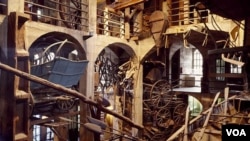
This is an example of a carefully collected, fascinating, but traditionally static museum exhibit - in this case, of old-time farm implements at the Mercer Museum in Doylestown, Pennsylvania. (Carol M. Highsmith)This is an example of a carefully collected, fascinating, but traditionally static museum exhibit - in this case, of old-time farm implements at the Mercer Museum in Doylestown, Pennsylvania. (Carol M. Highsmith)
x
This is an example of a carefully collected, fascinating, but traditionally static museum exhibit - in this case, of old-time farm implements at the Mercer Museum in Doylestown, Pennsylvania. (Carol M. Highsmith)

There, characters in 18th-Century costumes fire off cannons, parade like British soldiers, farm gardens using massive plow horses, sing drinking songs, and even serve up tankards of beer to go with them.  

And visitors get to put their heads and hands in the stocks for a photograph, help the tinsmith make spoons, or feed yarn to women in costume who are weaving.

But historical purists say all this fun stretches the truth of what life was really like which, in many cases, was hard, even brutal. They fuss that tourists come away enchanted but having learned very little.

The counter argument is that if visitors can discover even a few things about, say, America’s whaling tradition or the real First Thanksgiving - and have a good time doing it - that’s more than they’d get out of looking at a bunch of boring displays.

You May Like

India, China Pledge to Overcome Border Tensions

Indian prime minister and Chinese premier attempt to move past tense standoff in the Himalayas during Delhi talks More

Burmese President Opens US Visit with VOA Town Hall Meeting

Ahead of his meeting with President Obama Monday, Thein Sein answered questions on human rights and economic development in his country More

Video Washington Week: Focus on Burma, US Government Scandals

President Thein Sein visits the White House on Monday, Congressional probes of multiple scandals are continuing More

Featured Videos

Your JavaScript is turned off or you have an old version of Adobe's Flash Player. Get the latest Flash player.
Video

Video Boston Bomber Spent 6 Months in Russia’s Most Violent Republic

The news of the Boston Marathon bombings circled the globe, and resonated here in Dagestan, a majority Muslim republic in Russia, on the shores of the Caspian Sea. Last year, Tamerlan Tsarnaev, the older of two brothers suspected of the bombings and a long-time Boston resident, returned to Dagestan, where he had lived for a year during his youth. Dagestan was the land of his maternal ancestors. But in the last two years, this republic of 3 million people has gained notoriety as the region with the highest level of political and religious violence in all of Russia. VOA's James Brooke reports from Makhachkala, Russia.