


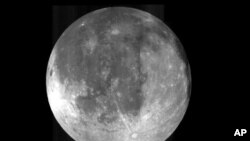
People in parts of the Americas, the Pacific and Asia might notice something unusual in the skies as a partial lunar eclipse begins at 10:17 Universal Time, or UTC, June 26 - the first lunar eclipse of 2010.
When the moon appears to disappear during a lunar eclipse, it is simply the act of casting a shadow on a truly grand scale.
Mitzi Adams, an astrophysicist at NASA's Marshall Space Flight Center in Alabama, explains the out-of-this-world phenomena in earthly terms.
"You could have a light source and one human body could come between that light source and another human body, and the human body would cast a shadow on the other human body," she said. "So it's just a shadow-casting kind of thing where light is blocked."
Replace the human bodies with the celestial bodies of the full moon and the Earth, and envision the sun as the light source, and you have a picture of the upcoming lunar eclipse. The Earth will be between the moon and the sun, and the moon will move into the shadow that the Earth will cast.
NASA says the June 26 partial lunar eclipse will begin at 10:17 Universal Time, or UTC, and be greatest at 11:38 UTC.
"About 50 percent of the face of the moon will be in shadow, and that's essentially what it is," said Adams. "It's the shadow of the Earth falling on the moon."
Observers in the South Pacific will have the best view of the entire celestial spectacle, but NASA says people in the western Americas will have a good view at moon set and people in eastern Asia will have a good view at moon rise, too.
Adams says that makes this partial lunar eclipse a bit unusual.
"I mean, it has happened before, but it is not as often observed by a large amount of people when an eclipse is close to either rising or setting, so that is rather unique," she said.
Adams explains that when the moon is close to the horizon, it often appears larger than it really is, making the effect that much more spectacular.
Observers can expect to see a dimming of the light of the moon, and the moon and its light can appear reddish because it will be refracted through the Earth's atmosphere. Overall, Adams notes, partial lunar eclipses are not as dramatic to behold as full lunar eclipses or solar eclipses.
"If you don't know it's going to be happening, you probably won't notice it," she said.
And, Adams stresses, there is no correlation between eclipses and natural disasters, and, she says, eclipses have no effect on navigational or GPS equipment. It is all simply an act of light and shadow.
For more NASA information on solar and lunar eclipses, see Fred Espenak's Eclipse Web Site.