



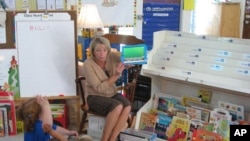
Many adults, who would be thrilled to be able to afford an iPad, might be surprised to learn there's a program in Maine which gives them to kindergarteners as part of a new learning initiative.
At Sherwood Heights Elementary School in Auburn, Laurie Gerard prepares her class for a session on the iPads. Before they collect their tablet-style, handheld computers, the 5 and 6 year olds recite a ditty reviewing the ground rules for using them:
"Fingers on the bottom, thumbs on top, that way my iPad won't drop."
While some criticize the iPad project as a waste of money, school officials expect the move to boost learning in some important academic areas.
“I was introducing our magnetic land application for the kids. We'll be using it for them to make names, words, we're doing word work," says Gerard. "And today we're just exploring so they get a feel for the application before they really get into it.”
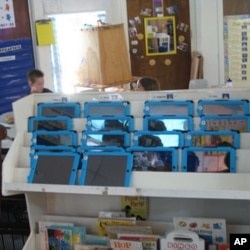
As the school year progresses, Gerard plans to use various iPad applications to come up with individualized learning plans for each student. The iPads have been in her classroom since classes began in September, and they quickly became a big hit.
Daniel Fitzgerald, 5, plays an interactive word game, trying to spell his name out using the iPad. "My favorite thing for the iPad is activities. Like playing like stuff and games."
Sherwood Heights principal Laura Shaw says iPads also provide children with immediate feedback.
“When you have 18 kids in the classroom and you see 10 kids, hands raised up, the teacher does her best to get around," she says. "But sometimes, with the iPads and certain apps, the kids get immediate feedback. They know what they've done is correct and they can move on, or they know 'Oh, I need to ask for help.'”
Nearly 300 kindergarteners in Auburn are taking part in the iPad program this year. Half of them - like Miss Gerard's class - have already started; the other half begin this month.
School officials say the staggered access to iPads will provide comparative data on the impact of students' use of the tablets.
Project coordinator Mike Muir believes the computers can help address a huge deficiency in literacy and math, where only 60 to 65 percent of third grade students are at benchmark levels. The recent experience of a colleague reinforced that belief.
“One of our literacy interventionists was working with several of her students, and having a hard time with helping them be successful, she finally pulled out her own personal iPad and had them work on some apps for letter recognition and letter formation. And they met the benchmark very quickly and, even as she moved on to other topics with these students, they retained that level of mastery.”
Most of the initial funding for the $200,000 project comes from state and federal grants, but Muir hopes the success of the initiative will make iPads a regular item in the school district’s budget.
There is a precedent for that. Nine years ago, Maine became the first in the nation to equip its middle school students with laptop computers, a program which now expands to about half of Maine’s high schools.
One of the critics of the Auburn iPad initiative is Elliot Soloway, a computer science professor at the University of Michigan who studies the interface between technology and education.
“It's ridiculous. And it's ridiculous, not because of the iPads but, because of the amount of money,” he says. “Technology is really a wonderful, wonderful idea but the problem is that the iPads won't scale. The iPads are not sustainable.”
Soloway also has his doubts about how useful the iPads are when it comes to teaching 5-year olds.
Nevertheless, the concept is taking hold in a number of states. School districts in South Carolina, Tennessee, Illinois and other places are adopting similar strategies.
As for the iPad's effectiveness as a learning tool in Maine, more will be known at the end of the school year, when the comparative data is released.