


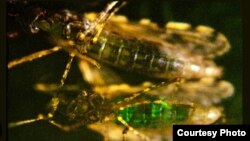
In the battle against malaria, doctors may one day have a microscopic ally.
New research suggests that genetically modifying a bacterium commonly found in the gut of mosquitoes that harbor the malaria-causing parasite can make the mosquitos less likely to carry the disease.
If scientists can find a way to spread these bacteria in the wild, they could help end malaria’s deadly reign in the tropics
New research suggests that genetically modifying a bacterium commonly found in the gut of mosquitoes that harbor the malaria-causing parasite can make the mosquitos less likely to carry the disease.
If scientists can find a way to spread these bacteria in the wild, they could help end malaria’s deadly reign in the tropics
Malaria kills approximately one million people every year, mostly African children under the age of 5.
Molecular biologist Marcelo Jacobs-Lorena, said, "It’s a very serious problem. It’s one of the three deadliest infectious diseases."
And, he said, it’s one that is very hard to control.
"We have just drugs that kill the parasite in humans and we have insecticides that kill the mosquito vector. And the parasite rather quickly acquires resistance to drugs and the mosquitoes are acquiring resistance to insecticides. So the situation doesn’t get better," he said.
Jacobs-Lorena is part of a team at Johns Hopkins and Duquesne Universities that is exploring an entirely new way to fight malaria. He says the key to success is choosing the right battleground. In this case, that battleground is inside the mosquito.
"Typically a mosquito ingests a couple thousand parasites. Then the parasite changes into a form called “ookinetes” that has to cross the midgut. Of the couple of thousand parasites that were ingested, only a few - about 5 or so-reach that stage where they cross the midgut. As you see, there’s a very strong bottleneck of parasite numbers in the midgut. That’s why it’s such a good target," he said.
To take aim at the malaria parasites, Jacobs-Lorena and his colleagues gave weapons, of a sort, to bacteria that often live in a mosquito’s digestive system.
"So what we did is genetically engineer the bacteria to produce several antimalarial compounds, (and we) fed them to the mosquitoes," he said.
When the newly-armed bacteria reached the mosquitoes’ midguts, they thrived. And Jacobs-Lorena says that they excelled in their new role as anti-parasite fighters. "In the laboratory, it works extremely well. Up to 98% of the parasites killed. So it is quite efficient," he said.
Jacobs-Lorena says it’s unlikely the malaria parasite will learn to fight back. "Rather than using one antimalarial compound, we engineered the bacteria with several different antimalarials, with each antimalarial acting at a different point in the development of the parasite in the midgut. By having multiple points of attack, that makes it much more difficult for the parasite to develop resistance," he said.
The team’s next hurdle is making sure mosquitoes can pass on “armed” bacteria to their offspring.
"We are changing to another bacteria that is also found in mosquitoes all over the world. It has the interesting property of being able to populate the ovaries of the mosquito. Every time the mother lays an egg, the egg is covered by this bacteria. So it goes into the water with the egg. And when the larva hatches, it ingests that bacterium. So it goes from the mother to progeny. In that way it can spread itself in nature," said Jacobs-Lorena.
But even if the team can engineer inheritable armed bacteria, they face a larger challenge: public opinion.
"I can understand very well the concerns of lay people of having genetically engineered organisms released. My personal view is that those concerns are mostly based on the fear of the unknown rather than actual dangers. The antimalarial compounds I referred to are extremely specific. They don’t act, or do any harm to the mosquito. They don’t do any harm to mammalian cells or human cells. They don’t even affect the other bacteria that live in the same community. And in the long run, if the benefits largely outweigh any possible risks, then I think we should go ahead. And here, I think the benefit is saving lives," he said.
Marcelo Jacobs-Lorena’s study is published this week in The Proceedings of the National Academy of Sciences.