



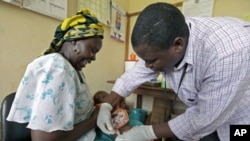
Malaria is an infectious disease caused in humans by a parasite transmitted by mosquitoes. Worldwide, about 250 million people come down with the disease annually, and nearly one million die.
"If you look at health structure in Africa, 30 to 40 percent of people coming for consultation are coming for malaria. At the same time malaria is the first cause of death of children under five," said Awa Marie Colle-Seck, who heads the Roll Back Malaria Partnership, the global framework for coordinated action against the disease.
Among those actively involved in the fight against malaria is South African recording artist and Roll Back Malaria Goodwill Ambassador Yvonne Chaka Chaka. She says the disease hit home several years ago when it killed one of her colleagues.
"In 2004 I traveled to Gabon and one of my musicians, Phumzile, died of malaria. It was so sad. If I knew what I know now, I would have tried to help," she said.
Chaka underscores the need for concerted action.
"We need the public, we need the government and we need the private sector to dig deep down in their pockets. But it is for the community as well to take it on and take the necessary precaution," she urged.
There have been some bright spots in the anti-malaria campaign.
The World Health Organization says today, a child dies from malaria every 45 seconds, compared to every 30 seconds in the recent past. Rwanda, for example, has successfully reduced malaria deaths by 60 percent. Kenya is also registering some successes.
Experts credit the progress to a combined approach -- the use of insecticide-treated bed nets, indoor residual spraying, Artemisinin-based combination therapy and rapid and accurate diagnosis.
As health care workers take small steps to save individual lives, the international community is proceeding with large-scale programs and research to stamp out the disease worldwide. One such study is conducted at John Hopkins University in Baltimore, Maryland. Scientists there are trying to genetically modify mosquitoes so they no longer carry malaria.
Roll Back Malaria Partnership’s Awa Marie Colle-Seck said researchers are also hopeful about the eventual development of an effective vaccine.
"A lot of teams are working on that but until now, what is clear is that we will need something like 10 years before having a vaccine," she said.