



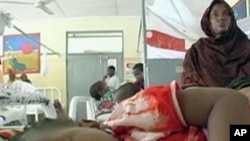
More than 2 million people die of malaria each year - a child every 45 seconds - with 90 percent of the cases in sub-Saharan Africa. That's why so much importance is placed on developing an effective vaccine.
Organic farmers in Africa complain that insecticides used to control mosquitos that carry the malaria parasitecontaminate their crops and hurt sales. And this Ugandan nurse says the insecticide of choice is no longer effective.
"It was realized that the mosquito had already developed resistance against the DDT," said Sam Dick Kale.
So in malaria-prone regions, bed nets treated with insecticides, and drug treatment, also are used. That has helped to cut the number of cases nearly in half, but some 800,000 Africans still die from malaria each year, most of them children under five.
Dr. Christian Loucq explains the challenges facing vaccine researchers. He is director of the PATH Malaria Vaccine Initiative that's conducting human trials in sub-Saharan Africa.
“It is difficult to develop a malaria vaccine because we are dealing with a complex organism a parasite which has many, many components and that parasite organism can change, it’s very versatile," said Dr. Loucq. "It’s quite difficult to develop immunity against that parasite.”
Dr. Loucq is hopeful the World Health Organization will approve the new vaccine by 2015.
“It will reduce the number of times a child is going to have malaria, clinical malaria, and it means reducing the number of opportunities for that child to die from malaria," he said.
The Malaria Vaccine Initiative also is trying to develop a second generation vaccine to prevent mosquitos from carrying the malaria parasite.
"Once the mosquito will come to take the blood meal - the mosquito will take the antibodies that are going to stop the cycle in the mosquito," said Loucq. "Therefore the mosquito will not be in a position to transmit malaria to another child, and that would be a fantastic way to stop the transmission of malaria."
Dr. Loucq says the new vaccine, called RTS,S, will be a major step toward getting rid of malaria. But for that to happen, he says, greater investment in research will be essential.