



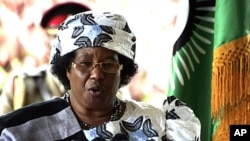
In Malawi, civil society groups have expressed concern that President Joyce Banda is not doing enough to stimulate the nation’s economy.
Ms. Banda became president eight months ago following the death of president Bingu Wa Mutharika.
Billy Mayaya, a leading member of the Civic and Political Space Platform group says the civil society groups will soon begin a series of nationwide protests to pressure Ms. Banda to create jobs.
“She has not put in place measures to show that she is committed to the process of economic reforms,” said Mayaya. “For example, she spends more than [$39,002] a day just to distribute maize, while she should be focusing on helping the people of Malawi understand that there is need for austerity measures across the board, starting from her office as president, down to the common citizen.”
Mayaya says the civil society groups now believe that President Banda may not have the political will to offer solutions that would lead to economic recovery.
But Information Minister Moses Kunkuyu rejects the accusations. He says the president has restored international donor confidence in Malawi.
“A lot of progress has been made the [business] friendly environment that we have as a nation and all other reforms that are there. [Now] you find fuel in the filling stations and if you pass by the banks you find forex [foreign currencies]. So, these are indications that the president has done well and that she deserves to be applauded,” said Kunkuyu.
Supporters of the president say Ms. Banda inherited a bad economy and that measures she has implemented will take more time to succeed.
Mayaya disagrees.
“For the economy to recover, she needs to inculcate a spirit of consumerism within Malawi, and that can only happen when there is more investment in the manufacturing industry and that is not being done,” he said.
Mayaya said Ms. Banda has yet to meet the expectations of Malawians.
“If we don’t see any more improvement, as civil societies, there are plans to hold demonstrations beginning January to show our displeasure,” he said.
Ms. Banda became president eight months ago following the death of president Bingu Wa Mutharika.
Billy Mayaya, a leading member of the Civic and Political Space Platform group says the civil society groups will soon begin a series of nationwide protests to pressure Ms. Banda to create jobs.
“She has not put in place measures to show that she is committed to the process of economic reforms,” said Mayaya. “For example, she spends more than [$39,002] a day just to distribute maize, while she should be focusing on helping the people of Malawi understand that there is need for austerity measures across the board, starting from her office as president, down to the common citizen.”
Mayaya says the civil society groups now believe that President Banda may not have the political will to offer solutions that would lead to economic recovery.
But Information Minister Moses Kunkuyu rejects the accusations. He says the president has restored international donor confidence in Malawi.
“A lot of progress has been made the [business] friendly environment that we have as a nation and all other reforms that are there. [Now] you find fuel in the filling stations and if you pass by the banks you find forex [foreign currencies]. So, these are indications that the president has done well and that she deserves to be applauded,” said Kunkuyu.
Supporters of the president say Ms. Banda inherited a bad economy and that measures she has implemented will take more time to succeed.
Mayaya disagrees.
“For the economy to recover, she needs to inculcate a spirit of consumerism within Malawi, and that can only happen when there is more investment in the manufacturing industry and that is not being done,” he said.
Mayaya said Ms. Banda has yet to meet the expectations of Malawians.
“If we don’t see any more improvement, as civil societies, there are plans to hold demonstrations beginning January to show our displeasure,” he said.
