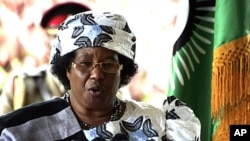
While some Malawian opposition members have criticized President Joyce Banda for making what they call a hasty decision in canceling next month’s African Union summit, one opposition leader said the decision is in Malawi’s national interest.
The African Union decided Monday to move the July 9-16 summit to Ethiopia’s capital, Addis Ababa, after Banda refused to let Sudanese President Omar al-Bashir, under indictment by the International Criminal Court for crimes against humanity, to attend.
Sam Mpasu, vice president of the United Democratic Front Party, said Banda’s decision saves Malawi from the threat of another round of economic sanctions from donor countries.
“As you know very well, the late President [Bingu wa] Mutharika was not in very good book with donors and, as a result, this country was suffering from economic sanctions. He was accused of economic mismanagement and bad governance. So, when President Joyce Banda came into power, she made a great effort to have those good relations with the donors re-established,” he said.
Mpasu said the threat of another round of sanctions was very frightening for many Malawians.
The African Union has criticized the International Criminal Court (ICC) indictments against Bashir saying they were "undermining African solidarity and African peace and security.”
Mutharika, when he was chairman of the African Union, said the arrest warrant against Bashir was undermining African solidarity and African peace and security.
Mpasu said Malawians were not concerned that their country would be ostracized because Banda’s decision on the Bashir arrest warrant is contrary to the African Union’s stance.
“Malawi is not alone holding this view that Bashir should be arrested and handed over to the ICC. I know, for example, Botswana, Zambia and others are of the same view. It is a question of respect for the rule of law, and I don’t expect the African Union will single out Malawi for this view,” Mpasu said.
He said the alleged human rights abuses in Sudan are a source of great sadness for many Malawians and other Africans.
Mutharika allowed Bashir to visit Malawi in October 2011 to attend the summit of Common Market for Eastern and Southern Africa (COMESA).
Mpasu said Banda has decided not to repeat the mistakes of her predecessor.
“Al-Bashir came here during the conference of COMESA, and Mutharika defied the West and donors. It’s one of the reasons why this economy was suffering from sanctions, and she has decided to become different on this issue, and we are supporting her,” Mpasu said.
The African Union decided Monday to move the July 9-16 summit to Ethiopia’s capital, Addis Ababa, after Banda refused to let Sudanese President Omar al-Bashir, under indictment by the International Criminal Court for crimes against humanity, to attend.
Sam Mpasu, vice president of the United Democratic Front Party, said Banda’s decision saves Malawi from the threat of another round of economic sanctions from donor countries.
“As you know very well, the late President [Bingu wa] Mutharika was not in very good book with donors and, as a result, this country was suffering from economic sanctions. He was accused of economic mismanagement and bad governance. So, when President Joyce Banda came into power, she made a great effort to have those good relations with the donors re-established,” he said.
Mpasu said the threat of another round of sanctions was very frightening for many Malawians.
The African Union has criticized the International Criminal Court (ICC) indictments against Bashir saying they were "undermining African solidarity and African peace and security.”
Mutharika, when he was chairman of the African Union, said the arrest warrant against Bashir was undermining African solidarity and African peace and security.
Mpasu said Malawians were not concerned that their country would be ostracized because Banda’s decision on the Bashir arrest warrant is contrary to the African Union’s stance.
“Malawi is not alone holding this view that Bashir should be arrested and handed over to the ICC. I know, for example, Botswana, Zambia and others are of the same view. It is a question of respect for the rule of law, and I don’t expect the African Union will single out Malawi for this view,” Mpasu said.
He said the alleged human rights abuses in Sudan are a source of great sadness for many Malawians and other Africans.
Mutharika allowed Bashir to visit Malawi in October 2011 to attend the summit of Common Market for Eastern and Southern Africa (COMESA).
Mpasu said Banda has decided not to repeat the mistakes of her predecessor.
“Al-Bashir came here during the conference of COMESA, and Mutharika defied the West and donors. It’s one of the reasons why this economy was suffering from sanctions, and she has decided to become different on this issue, and we are supporting her,” Mpasu said.