



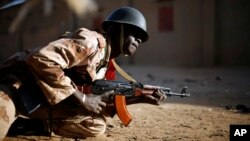
The conflict in northern Mali is threatening the country’s food security. Many farmers are among the hundreds of thousands of people who’ve been displaced. The U.N. Food and Agriculture Organization said the next planting season is in jeopardy.
Daniele Donati, the FAO’s Chief of Emergency Operations, said that affects both internally displaced persons and those who’ve fled to neighboring countries.
“The major concern in this moment is the next campaign, which starts in May. There is an estimated 230 – 240,000 IDPs in the country and 140 – 150,000 refugees in the sub-region. We need to provide them basic packages to resume normal agricultural activities,” he said.
There are other problems affecting Mali’s food security, as well.
“The fact that borders are closed is limiting trade and the availability of some basic commodities. Prices are going up. And if they don’t resume normal agricultural activities they will have little to eat for the coming nine months,” he said.
The FAO reported that even before the conflict, Mali was feeling the effects of a 2011 / 2012 drought, along with high grain prices.
Many of the displaced farmers are reported to be in refugee camps or with host families in Burkina Faso, Mauritania and Niger. Others fled to southern Mali.
Donati said, “They lost everything because they are away from their places. They don’t have agricultural tools. They don’t have basic seeds. And their animals are also at risk because there is no availability of veterinary drugs and so on. This is also a major challenge for the displaced households because animals represent years of savings. It’s a lifetime of savings.”
The FAO said efforts should be made to grow vegetables on what land is available near the displaced and in refugee camps. It’s also appealing to donors for $12 million in humanitarian aid. It would be used to help about 500,000 people cope with current conditions and build more weather resilient agricultural systems. Another $10 million is needed, it said, to assist the newly displaced and families who are sharing their homes and food with them.
FAO Director-General Jose Graziano da Silva has held talks with Mali’s agricultural minister about resuming food production when the security situation permits.

Daniele Donati, the FAO’s Chief of Emergency Operations, said that affects both internally displaced persons and those who’ve fled to neighboring countries.
“The major concern in this moment is the next campaign, which starts in May. There is an estimated 230 – 240,000 IDPs in the country and 140 – 150,000 refugees in the sub-region. We need to provide them basic packages to resume normal agricultural activities,” he said.
There are other problems affecting Mali’s food security, as well.
“The fact that borders are closed is limiting trade and the availability of some basic commodities. Prices are going up. And if they don’t resume normal agricultural activities they will have little to eat for the coming nine months,” he said.
The FAO reported that even before the conflict, Mali was feeling the effects of a 2011 / 2012 drought, along with high grain prices.
Many of the displaced farmers are reported to be in refugee camps or with host families in Burkina Faso, Mauritania and Niger. Others fled to southern Mali.
Donati said, “They lost everything because they are away from their places. They don’t have agricultural tools. They don’t have basic seeds. And their animals are also at risk because there is no availability of veterinary drugs and so on. This is also a major challenge for the displaced households because animals represent years of savings. It’s a lifetime of savings.”
The FAO said efforts should be made to grow vegetables on what land is available near the displaced and in refugee camps. It’s also appealing to donors for $12 million in humanitarian aid. It would be used to help about 500,000 people cope with current conditions and build more weather resilient agricultural systems. Another $10 million is needed, it said, to assist the newly displaced and families who are sharing their homes and food with them.
FAO Director-General Jose Graziano da Silva has held talks with Mali’s agricultural minister about resuming food production when the security situation permits.