


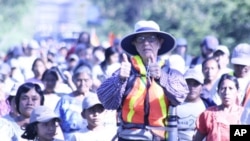
More than a year ago, Bob Hentzen, 74, set out on a remarkable journey - to walk with the poor in order to raise awareness of their plight. Since leaving his home in Guatemala, he's walked through El Salvador, Honduras, Nicaragua, Costa Rica, Venezuela, Colombia, Ecuador and Peru. Hentzen and his supporters have covered more than 9,000 of the planned 13,000-kilometer-long route to Valparaíso, Chile.
"We get up very early on a daily basis. We begin at a point where we had stopped yesterday. We’re careful to really, really walk the entire distance that we have promised," says Hentzen. "We are able to do the equivalent of a marathon, of 25 miles (40 kilometers) per day. And almost always we’re able to finish before the nightfall."
Twenty years ago, Hentzen, his brother, sister and a family friend established the Christian Foundation for Children and Aging, to help poor families in Central and South America, Africa, Asia and the Caribbean. CFCA is now serving people of all faiths in 23 developing countries.
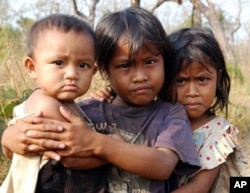
Walking is the most common means of transportation for the poor in those countries. They walk to school and work, to gather firewood and fill buckets with water. That’s why Hentzen decided to walk and meet with some of the people sponsored by his organization.
"The idea is to walk with them, tell them you are not alone. We honor your struggle. We’re here to listen and learn and be with you. Along that route we have all these struggling families who are sponsored by the Christian Foundation," says Hentzen. "What we’re finding, however, is that there is so many others out there. This is why we decided that we really want to find sponsors for 8,000 kids as a result of these 8,000 miles. That is our campaign."
On an average day, he says, he’s accompanied by a crowd of about 50. Some are CFCA staff, dozens of others are enthusiastic international volunteers and people from the local communities.
"At one point we had nine different nationalities. We had Peter from Nairobi, Kenya. We had Uganda represented. We had Honduras, Guatemala, the (United) States and the Dominican Republic. It’s very exciting because in the different countries, when they hear about us and see this is an international trek and it’s coming through our country, they really respond beautifully. They say, ‘Oh, we’ll get you police protection. We’ll take care of you on the road.’ They are very kind and concerned that they really want to do a good job and they really have done (that) along the way."
Walking side by side with the locals, he says, offers a unique opportunity to listen to the stories of their struggle against poverty.
"They are hopeful stories, they are not sad stories. I’ve seen areas in Guatemala, for example, where we used to have to truck in food, they are now producing food and selling it. We have doctors, we have accountants, social workers walking with us who have grown up as sponsored children, got their education. Some of them then come to work with us as social workers."
Paul Pearce, CFCA’s international program director, joined several different stretches of the Walk2gether campaign. "I was just recently in Bolivia where I observed one of our former sponsored youths who went into agricultural sciences. He has now led a program of food production within one of the mountain communities...So this is a case of an individual student who now is creating change and creating more food security for an entire community."
That, Pearce says, sums up CFCA’s approach to fighting poverty.
"We really help the individual person or family to go from frankly marginalized to an agent of change in their own situation and in their own family and then of course within the larger community. And we hope through that we are able to build stronger community fabric by people who feel now that they are part of the decision making processes that are affecting their lives."
Successes like that have convinced Hentzen that ending poverty is possible, if people are committed to the cause.
"I see it basically as a very human situation. If we personally can get to a point where we can say, 'I can commit myself to this not from a distance, but in a very personal way. I’m going to live a life style that will be simpler, use less water maybe, be very concerned about others and take care of the environment.'"
Now in Bolivia, Hentzen heads east to Brazil, before returning to the Pacific coast, and the Walk2gether campaign’s final stretch this summer in Chile.