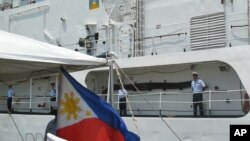
SEOUL - A tense naval standoff stemming from competing territorial claims between China and the Philippines is throwing a spotlight on an obscure treaty between Manila and Washington. But contemporary political considerations may trump the decades-old agreement.
The Mutual Defense Treaty between the United States and the Philippines is being dusted off in both Washington and Manila by diplomats and politicians, many of whom were not even born when it was written in 1951.
Officials are trying to determine whether the United States is compelled to come to the aid of Manila should there be a military clash between the Philippines and China in an isolated lagoon some 200 kilometers west of Subic Bay.
For more than a month both the Philippines and China have had ships posted around Scarborough Shoal after Chinese vessels prevented a Philippines naval vessel from arresting Chinese fishermen.
Both the Philippines and China claim the waters.
Unclear US response
The treaty between Manila and Washington makes no explicit mention of the South China Sea. But the Philippines' Foreign Ministry is circulating letters it received from U.S. officials in 1979 and 1999 as evidence the treaty extends to its territorial claims in the South China Sea. Those include the shoal as well as some of the Spratly Islands, which are claimed by several countries.
U.S. Secretary of State Hillary Clinton last year said the United States "will honor its treaty obligations to the Philippines" but would not speak about how America would respond to - as she put it - “hypothetical events” such as a Chinese attack on Filipino forces in the uninhabited Spratlys.
Senior fellow Denny Roy at the East West Center in Hawaii contends too much attention is being paid to the treaty's language and subsequent related statements of years past.
"Rather I would look at it from a more of a bird's eye perspective of what is in the United States' best interest to do in possible scenarios that we can foresee here. And certainly the United States and China getting into a shooting war with each other over any of the Spratly so-called islands would be insane," he said. "Neither the United States nor China is going to knowingly enter into an insane situation based on pieces of paper."
Manila's view
The Philippines by itself, with an aging naval fleet or about a dozen light warships and not a single fighter jet, would find itself outgunned by a formidable Chinese force.
Thus, Roy explains, it is no surprise Manila is asserting the United States is obligated to come to its aid in the event of such a conflict.
"Of course," says Roy, "the Philippines has an interest in taking the strongest possible interpretation of the Mutual Defense Treaty with the United States - that is roping in the United States as strongly as possible. But we should understand here that all the players have their own specific agenda and that of the Philippines is to advance their claims now while they have their opportunity. It'll be more difficult in the future when forces that China is able to project in the area will be stronger."
Complicated emotions
For Filipinos, asking the United States for military support is fraught with complicated emotions.
The country is a former U.S. colony and American forces liberated the Philippines from Japanese occupation during World War II. But rising anti-American sentiment in the post-war era led to the Philippines Senate, in 1991, voting to close U.S. military bases in the country. The 1951 defense treaty of the Cold War era, however, was not scrapped.
As Philippines University professor emeritus Carolina Hernandez notes, some of those who decades ago campaigned to get the U.S. military out of the country have lately had a change of heart.
"Even within the segments of the left-wing groups there is this recognition that the Philippines cannot hold its own against the Chinese. And therefore because the strategic interests of the United States in the South China Sea - the West Philippines Sea - and the Philippines at this particular point in time are compatible there is the expectation that the United States will come to defend the mutual interests of both countries," she said.
Hernandez, the founding president of the Institute for Strategic and Development Studies in Manila, explains many Filipinos fret about trade ties between Washington and Beijing trumping America's strategic interest in the Philippines, which stretches back to 1898.
Chinese dilemma
"There are those that still think that the U.S. is unreliable," said Hernandez. "These people do not think that the United States will risk its fragile relationship with China to defend maritime interests in the Philippines, will not come to the aid of the Philippines because the bilateral U.S.-China relations is hugely important in the new configuration of power, not just in the region but in the world."
Former U.S. Undersecretary of State John Bolton says that would be a mistake.
"The Philippines are entitled to assert their legitimate claims to what they think their territory is, based on the geology and the history and treaties and so on. And, I think the consensus is that it is really China whose territorial claims are way out of line," he said.
Bolton says Washington should encourage the Association of Southeast Asian Nations (ASEAN) to work out their own maritime territorial disputes so they can create a united stance to demonstrate, along with the United States, that Chinese attempts to take control of international waters will not be tolerated.
Bolton, who also served as the U.S. ambassador to the United Nations, predicts China will "probe and push" its maritime claims as far as it can until it meets serious resistance.
"And I'm afraid they're going to try and take advantage of U.S. attention on the upcoming election," he said. "They see the risk that Obama could be defeated so they're going to push as hard as they can with a weak president in the White House. That's why I think there's a real incentive for the ASEAN countries to try to pull together here in the short term."
Some analysts contend it would be wrong for Beijing to perceive the current U.S. administration as a potential appeaser. They say Washington would certainly consider dispatching a 7th Fleet carrier battle group to reclaim the contested shoal should China's superior forces overwhelm the Philippines navy. There are those who predict, in the short term, all sides will find a face-saving way to lessen the tension.
But that will still leave unresolved broader territorial disputes in the region at a time when China is asserting claims in the resource-rich and strategic South China Sea and the United States is demonstrating it intentions to remain a Pacific power.
The Mutual Defense Treaty between the United States and the Philippines is being dusted off in both Washington and Manila by diplomats and politicians, many of whom were not even born when it was written in 1951.
Officials are trying to determine whether the United States is compelled to come to the aid of Manila should there be a military clash between the Philippines and China in an isolated lagoon some 200 kilometers west of Subic Bay.
For more than a month both the Philippines and China have had ships posted around Scarborough Shoal after Chinese vessels prevented a Philippines naval vessel from arresting Chinese fishermen.
Both the Philippines and China claim the waters.
Unclear US response
The treaty between Manila and Washington makes no explicit mention of the South China Sea. But the Philippines' Foreign Ministry is circulating letters it received from U.S. officials in 1979 and 1999 as evidence the treaty extends to its territorial claims in the South China Sea. Those include the shoal as well as some of the Spratly Islands, which are claimed by several countries.
U.S. Secretary of State Hillary Clinton last year said the United States "will honor its treaty obligations to the Philippines" but would not speak about how America would respond to - as she put it - “hypothetical events” such as a Chinese attack on Filipino forces in the uninhabited Spratlys.
Senior fellow Denny Roy at the East West Center in Hawaii contends too much attention is being paid to the treaty's language and subsequent related statements of years past.
"Rather I would look at it from a more of a bird's eye perspective of what is in the United States' best interest to do in possible scenarios that we can foresee here. And certainly the United States and China getting into a shooting war with each other over any of the Spratly so-called islands would be insane," he said. "Neither the United States nor China is going to knowingly enter into an insane situation based on pieces of paper."
Manila's view
The Philippines by itself, with an aging naval fleet or about a dozen light warships and not a single fighter jet, would find itself outgunned by a formidable Chinese force.
Thus, Roy explains, it is no surprise Manila is asserting the United States is obligated to come to its aid in the event of such a conflict.
"Of course," says Roy, "the Philippines has an interest in taking the strongest possible interpretation of the Mutual Defense Treaty with the United States - that is roping in the United States as strongly as possible. But we should understand here that all the players have their own specific agenda and that of the Philippines is to advance their claims now while they have their opportunity. It'll be more difficult in the future when forces that China is able to project in the area will be stronger."
Complicated emotions
For Filipinos, asking the United States for military support is fraught with complicated emotions.
The country is a former U.S. colony and American forces liberated the Philippines from Japanese occupation during World War II. But rising anti-American sentiment in the post-war era led to the Philippines Senate, in 1991, voting to close U.S. military bases in the country. The 1951 defense treaty of the Cold War era, however, was not scrapped.
As Philippines University professor emeritus Carolina Hernandez notes, some of those who decades ago campaigned to get the U.S. military out of the country have lately had a change of heart.
"Even within the segments of the left-wing groups there is this recognition that the Philippines cannot hold its own against the Chinese. And therefore because the strategic interests of the United States in the South China Sea - the West Philippines Sea - and the Philippines at this particular point in time are compatible there is the expectation that the United States will come to defend the mutual interests of both countries," she said.
Hernandez, the founding president of the Institute for Strategic and Development Studies in Manila, explains many Filipinos fret about trade ties between Washington and Beijing trumping America's strategic interest in the Philippines, which stretches back to 1898.
Chinese dilemma
"There are those that still think that the U.S. is unreliable," said Hernandez. "These people do not think that the United States will risk its fragile relationship with China to defend maritime interests in the Philippines, will not come to the aid of the Philippines because the bilateral U.S.-China relations is hugely important in the new configuration of power, not just in the region but in the world."
Former U.S. Undersecretary of State John Bolton says that would be a mistake.
"The Philippines are entitled to assert their legitimate claims to what they think their territory is, based on the geology and the history and treaties and so on. And, I think the consensus is that it is really China whose territorial claims are way out of line," he said.
Bolton says Washington should encourage the Association of Southeast Asian Nations (ASEAN) to work out their own maritime territorial disputes so they can create a united stance to demonstrate, along with the United States, that Chinese attempts to take control of international waters will not be tolerated.
Bolton, who also served as the U.S. ambassador to the United Nations, predicts China will "probe and push" its maritime claims as far as it can until it meets serious resistance.
"And I'm afraid they're going to try and take advantage of U.S. attention on the upcoming election," he said. "They see the risk that Obama could be defeated so they're going to push as hard as they can with a weak president in the White House. That's why I think there's a real incentive for the ASEAN countries to try to pull together here in the short term."
Some analysts contend it would be wrong for Beijing to perceive the current U.S. administration as a potential appeaser. They say Washington would certainly consider dispatching a 7th Fleet carrier battle group to reclaim the contested shoal should China's superior forces overwhelm the Philippines navy. There are those who predict, in the short term, all sides will find a face-saving way to lessen the tension.
But that will still leave unresolved broader territorial disputes in the region at a time when China is asserting claims in the resource-rich and strategic South China Sea and the United States is demonstrating it intentions to remain a Pacific power.