



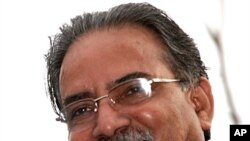
The leader of Nepal's Maoists, who have enforced a mostly peaceful shutdown of the Himalayan country since Saturday, is warning that the tone of the street demonstrations will change if the governing coalition does not immediately heed their demands.
Listen to Steve Herman's report
The Maoists, in their latest demonstration of power, had their followers form a 27-kilometer-long human chain around the capital for two hours in the afternoon.
The Maoist chairman, who is the country's previous prime minister, Pushpa Kamal Dahal, rode along Kathmandu's Ring Road atop an open truck.
The Maoist leader, better known as Prachanda, speaking to reporters, warned that the other major parties should understand the consequences if they do not immediately agree to form a national unity government with the former rebels.
He says the street action, so far, has been peaceful and the party does not want to resort to violence or rioting. But if the governing coalition does not agree to the Maoists' demands then, he said, the demonstrations might take a turn for the worse, deteriorating each day from Wednesday.
The Maoists, who won the largest number of parliamentary seats in the last election, have been insisting that Prime Minister Madhav Kumar Nepal step down.
But Mr. Nepal has the support of 22 of 25 political parties, enough to block the Maoists from legally changing the government. The ruling coalition accuses the Maoists, who quit the government last year, of trying to retake power through intimidation on the streets.
For many in Kathmandu, the indefinite strike enforced by Maoist cadres with bamboo sticks is an increasing annoyance. Motorized transportation has been halted, schools are closed and shops are open only for a few hours in the morning and evening so people can buy essentials.
Devi Tiwari, who runs a small food and sundries store in the middle class Ranibari neighborhood of the capital, says she normally sees sales totaling about $55 a day.
But now, she says she is taking in only about $20 a day. Tiwari says the strike is not good for people who need to make money every day.
About 50 meters away at another shop, proprietor Sabita Pokhrel says she has no objections to the Maoist strike. She says that because she is permitted to open twice a day the strike is having little impact, with her sales holding steady.
Many customers of such shops, however, are complaining that the disruptions are causing prices to skyrocket.
Fearing what they call a potential catastrophe, some civil society leaders are calling for the Maoists to end the crippling nationwide strike and for Prime Minister Nepal to immediately resign.
The statement by the Citizens Movement for Democracy and Peace, includes a number of respected civil leaders.
An anticipated new round of talks among Nepal's three top political parties to resolve the crisis was not held on Tuesday and no face-to-face meetings that would bring together the Maoists, the Nepali Congress Party and the United Marxist Leninist Party are scheduled for Wednesday.