


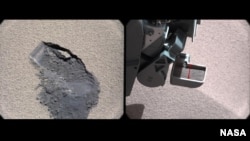
The soil on Mars appears to be very similar to the volcanic soils of Hawaii, according to scientists at the National Aeronautics and Space Administration, NASA.
The results come after the first chemical and mineralogy tests performed on Martian soil scooped up and taken aboard NASA’s Mars rover, Curiosity. NASA said the soil analysis was carried out by the rover’s Chemistry and Mineralogy instrument (CheMin).
The U.S. space agency said the study concluded that the Mars soil sample “is similar to weathered basaltic soils of volcanic origin in Hawaii.”
"Our team is elated with these first results from our instrument," said David Blake of NASA Ames Research Center in Moffett Field, Calif. "They heighten our anticipation for future [chemistry and mineralogy] analyses in the months and miles ahead for Curiosity."
Curiosity scooped up the sample in an area of Mars called NASA scientists call “Rocknest.”
The sample was then sifted to exclude any particles larger than 0.006 inch (150 micrometers), roughly the width of a human hair. Scientists said the sample contained two basic components dust and sand.
"Much of Mars is covered with dust, and we had an incomplete understanding of its mineralogy," said David Bish, CheMin co-investigator with Indiana University in Bloomington. "We now know it is mineralogically similar to basaltic material, with significant amounts of feldspar, pyroxene and olivine, which was not unexpected. Roughly half the soil is non-crystalline material, such as volcanic glass or products from weathering of the glass."
Bish said, "So far, the materials Curiosity has analyzed are consistent with our initial ideas of the deposits in Gale Crater, recording a transition through time from a wet to dry environment. The ancient rocks, such as the conglomerates, suggest flowing water, while the minerals in the younger soil are consistent with limited interaction with water."
Identifying the composition of the Martian soil is crucial to the Curiosity mission because it will help assess past environmental conditions on the planet and suggest whether those conditions may have been favorable to life.
The nuclear powered, one-ton rover, will also hunt for evidence of microbes on Mars and harvest a host of data and images from the planet. It is equipped with 17 cameras, a robotic arm, a laser and a drill.
The Curiosity rover successfully landed on Mars in August beginning a two-year, $2.5 billion mission.
The results come after the first chemical and mineralogy tests performed on Martian soil scooped up and taken aboard NASA’s Mars rover, Curiosity. NASA said the soil analysis was carried out by the rover’s Chemistry and Mineralogy instrument (CheMin).
The U.S. space agency said the study concluded that the Mars soil sample “is similar to weathered basaltic soils of volcanic origin in Hawaii.”
"Our team is elated with these first results from our instrument," said David Blake of NASA Ames Research Center in Moffett Field, Calif. "They heighten our anticipation for future [chemistry and mineralogy] analyses in the months and miles ahead for Curiosity."
Curiosity scooped up the sample in an area of Mars called NASA scientists call “Rocknest.”
The sample was then sifted to exclude any particles larger than 0.006 inch (150 micrometers), roughly the width of a human hair. Scientists said the sample contained two basic components dust and sand.
"Much of Mars is covered with dust, and we had an incomplete understanding of its mineralogy," said David Bish, CheMin co-investigator with Indiana University in Bloomington. "We now know it is mineralogically similar to basaltic material, with significant amounts of feldspar, pyroxene and olivine, which was not unexpected. Roughly half the soil is non-crystalline material, such as volcanic glass or products from weathering of the glass."
Bish said, "So far, the materials Curiosity has analyzed are consistent with our initial ideas of the deposits in Gale Crater, recording a transition through time from a wet to dry environment. The ancient rocks, such as the conglomerates, suggest flowing water, while the minerals in the younger soil are consistent with limited interaction with water."
Identifying the composition of the Martian soil is crucial to the Curiosity mission because it will help assess past environmental conditions on the planet and suggest whether those conditions may have been favorable to life.
The nuclear powered, one-ton rover, will also hunt for evidence of microbes on Mars and harvest a host of data and images from the planet. It is equipped with 17 cameras, a robotic arm, a laser and a drill.
The Curiosity rover successfully landed on Mars in August beginning a two-year, $2.5 billion mission.