



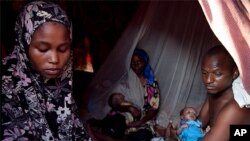
Two decades of civil war in Somalia have made the country one of the most dangerous places in the world for a woman to give birth.
The World Health Organization says Somalia has one of the highest maternal mortality rates in the world. In southern Somalia, the situation is grave, and the recent famine has made the health crisis for mothers and infants even worse.
In camps for internally displaced people in Mogadishu, women give birth in their tents. If there are complications, they are either taken to the clinic in the camp or, if the resources exist, transported to one of Mogadishu’s three hospitals.
At the Medina Hospital, which focuses on trauma and emergency maternal medicine, nearly 200 women give birth every month. The director, Dr. Mohamed Yusuf, says the famine is straining the hospital's already limited capacity.
"A lot of people who are IDPs today, you can imagine how they are malnourished while they are in pregnancy," Yusuf said. "And the premature delivery is frequent here, and not having an incubator is another problem.”
A lack of equipment in Somalia is endemic. There are no neonatal facilities in the south. And without respirators or incubators - caring for premature babies is difficult. The closest incubator can be found 846 kilometers north in Hargeisa, the capital of the autonomous region of Somaliland.
In Hargeisa, Edna Adan Ismail, a British-trained midwife and the former first lady of Somaliland, established a private maternity and training hospital in 2002.
She believes training is the key to improving healthcare, but that is just part of the challenge. Both her hospital and Medina Hospital are understaffed because they cannot compete with salaries offered by international organizations.
“The biggest pirates of the staff that we train are the international organizations working in the Horn of Africa and Somaliland," Ismail said. "When we are training these nurses and midwives, they don’t support you because they say 'Oh no no. This is not in our budget,' and as soon as you’ve trained them, then they offer them salaries and they steal them from you.”
Another challenge facing medical providers in Mogadishu and Hargeisa is the Somali custom rooted in Islam that requires a man’s consent to treat female patients. Often the father or husband will disagree with the doctor’s recommendations for surgery. In emergency situations, this negotiation can be time-consuming and often fatal.
“They just say she will deliver by the will of God, so let’s just wait," said Dr. Nimo Abdi Hasan from Medina Hospital. "Sometimes they refuse C-section, so we just wait until they allow. If they don’t allow, we just discharge the patient, tell them to take them somewhere else because we can’t have death on our hands if we can do something.”
Edna Adan Ismail believes it is a permanent feature of Somalia society that must be worked around.
“That is our custom; that is our culture," she said. "The husband is the person who is responsible for that woman and he should give consent because he is going to be footing the bill anyway. So even when she can afford to pay for herself, the custom is that the husband approves.”
Patients wait at the Banadir Maternity and Children's Hospital in Mogadishu, December 14, 2011. (VOA - R. Gogineni)
World Health Organization figures show that maternal and infant mortality rates in Somaliland have improved since its decision to break away from Somalia in 1991.
Experts says the rest of Somalia has been left behind because it has not had a functioning government for near two decades. While Somaliland has an unrecognized but functioning government, has worked to develop state institutions to provide public services and a government-run hospital.