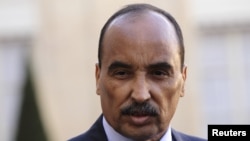
Mauritanian President Mohamed Ould Aziz is heading back to France for more medical treatment for the bullet wounds he sustained last month.
In a news conference late Thursday, Aziz said he would spend five to 10 days undergoing medical tests in Paris.
Aziz returned to Mauritania from France less than a week ago, after being shot by one of his own soldiers in October, in what his government says was an accident.
During the news conference, Aziz also warned against military intervention in neighboring Mali, where al-Qaida-linked militants have controlled the north and imposed Islamic law for the past several months.
Aziz said foreign intervention could have serious consequences.
The French News Agency says Aziz warned that citizens in northern Mali could feel threatened by foreign intervention and, as a result, could form alliances with terrorists in the region.
The African Union and the Economic Community of West African States (ECOWAS) have agreed on a plan to send troops into Mali.
However, in a Wednesday report to the U.N. Security Council, U.N. chief Ban Ki-moon said "fundamental questions" remain about sustaining the mission. Ban also warned that a poorly executed mission could worsen the Mali's humanitarian situation and lead to "severe human rights abuses."
Some information for this report was provided by AP, AFP and Reuters.
In a news conference late Thursday, Aziz said he would spend five to 10 days undergoing medical tests in Paris.
Aziz returned to Mauritania from France less than a week ago, after being shot by one of his own soldiers in October, in what his government says was an accident.
During the news conference, Aziz also warned against military intervention in neighboring Mali, where al-Qaida-linked militants have controlled the north and imposed Islamic law for the past several months.
Aziz said foreign intervention could have serious consequences.
The French News Agency says Aziz warned that citizens in northern Mali could feel threatened by foreign intervention and, as a result, could form alliances with terrorists in the region.
The African Union and the Economic Community of West African States (ECOWAS) have agreed on a plan to send troops into Mali.
However, in a Wednesday report to the U.N. Security Council, U.N. chief Ban Ki-moon said "fundamental questions" remain about sustaining the mission. Ban also warned that a poorly executed mission could worsen the Mali's humanitarian situation and lead to "severe human rights abuses."
Some information for this report was provided by AP, AFP and Reuters.