


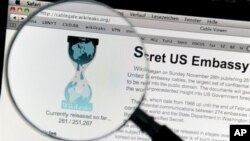
Sensitive information released by the Wikileaks website has generated a heated debate in the United States. Should the news media publish classified information and does it compromise national security?
State secrets revealed by Wikileaks have unleashed endless news reports about information the U.S. government would rather not be made public.
"We have more of an expectation in this country that we are entitled to this information. We are entitled to know what our government is doing with our tax money," said Lucy Dalglish, the executive director of The Reporters Committee for Freedom of the Press. She says Americans have the right to speak freely without government censorship. And that includes journalists. The exception is if great harm or violence results in what is said or published.
Former CIA analyst James Bruce says publishing classified information harms U.S. national security because it reveals secrets to America's enemies. "When they monitor the U.S. press, they discover enormously valuable pearls of understanding about how we collect intelligence information and they use that information to develop counter measures to our collection capabilities. Typically the press has no real idea, has no technical understanding of the damage what that can cause," he said.
"We don't just willy-nilly take classified information and put it out there. If we are not experts in an area, (we) see experts to make sure that the information we're presented, first of all, is accurate to give perspective," said Hagit Limor, the president of the Society of Professional Journalists. She says reporters have the responsibility to weigh any potential harm, and to verify information before publishing a story. "We're only looking for information that we feel adds to the public debate, perhaps question how government might do things in order to find better ways to do them. That's our role," she said.
But James Bruce argues that journalists lack accountability themselves. "I believe the Department of Justice has been excessively inhibited and restrained in its ability to identify and to hold accountable journalists who traffic, and there are several who do, in highly classified information," he said.
The U.S. government has not successfully prosecuted the media for publishing stories based on receiving classified information. And now with the Internet making secrets even more vulnerable, some lawmakers want to update the 1917 Espionage Act to better protect classified information.