


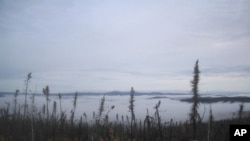
The melting arctic permafrost could release methane-producing microbes with the potential to accelerate climate change, according to a new study published in Nature.
Lead author Janet Jansson, senior scientist at the Lawrence Berkeley National Laboratory in California says the trapped microorganisms in permafrost are still active.
Jansson and colleagues at the U.S. Geological Survey and the Joint Genome Institute at the Department of Energy set out to identify microbes in permafrost and find out what they would do once thawed.
“They had never been cultured," Jansson says. "So more than 90 percent of those bacteria and other microorganisms in permafrost, we had no idea what they were.”
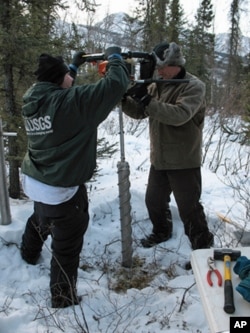
The researchers analyzed three soil cores from the soft, peat floor of a black-spruce forest in central Alaska. A single gram of that soil could harbor thousands of different species and billions of cells.
Jansson says the fact that those microorganisms had never been grown in the laboratory made them difficult to study. What they did instead, she says, was to extract the total DNA from the samples. "We used a sequencing approach to get information about both the identities of the microorganisms and also all of the bio-chemical pathways that they had in the permafrost before and after thaw.”
The team identified single-celled organisms that feast on organic material in the soil and produce methane, a greenhouse gas more potent than carbon dioxide. Jansson says methane-eaters were also among the microbes in the thawed permafrost. “Some of the methane was being consumed by other microorganisms in the samples, and they in turn would release, CO2, carbon dioxide.”
The scientists compared samples from the upper permafrost layer - which melts and refreezes seasonally - and the permanently frozen permafrost in which microbes have been trapped for millennia.
While initially very different the two samples became more similar after thawing, Jansson says. “Those two very disparate samples started to converge, both the microorganisms that were present and also their functions started to converge and became much more similar to what we saw in the seasonally thawed active layer samples.”
Jansson says understanding how microbes respond during a thaw can help improve models that chart the earth’s climate.