News / Europe

    Germany to Support Turkey's EU Bid in Exchange for Cooperation on Migrants

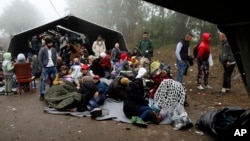
    A group of migrants wait to cross a border line between Serbia and Croatia, near the village of Berkasovo, about 100 kilometers (62 miles) west of  Belgrade, Serbia, Oct. 18, 2015.
    A group of migrants wait to cross a border line between Serbia and Croatia, near the village of Berkasovo, about 100 kilometers (62 miles) west of Belgrade, Serbia, Oct. 18, 2015.
    VOA News

    Germany is offering to support Turkey's faster track into the European Union on condition that Ankara helps alleviate Europe's growing immigration crisis.

    German Chancellor Angela Merkel made the announcement Sunday in Istanbul after talks with Turkish Prime Minister Ahmet Davutoglu.

    In return, Turkey is expected to sign an agreement to take back migrants returned by the EU.

    "But of course we also have some expectations in return," Merkel said. "There is an agreement on migrants between Turkey and the European Union and this holds true for third countries as well, but of course visa liberalization and readmission agreements should also go into effect. Another issue is to share the burden."

    Davutoglu said he would sign the so-called "readmission agreements" only if there is progress on liberalizing the EU visa regime for Turks.
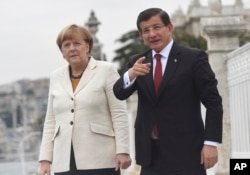
    Turkish Prime Minister Ahmet Davutoglu, right, talks to Germany's Chancellor Angela Merkel, left, during their meeting on the grounds of his office in Dolmabahce Palace in Istanbul, Oct. 18, 2015.
    Turkish Prime Minister Ahmet Davutoglu, right, talks to Germany's Chancellor Angela Merkel, left, during their meeting on the grounds of his office in Dolmabahce Palace in Istanbul, Oct. 18, 2015.

    "We are ready to fight against illegal migration, against human traffickers who exploit desperate people," Davutoglu said. "Turkey is ready for all kinds of cooperation with this regard. Immigration is a case but this should be legal and coordinated. Turkey and Germany will work shoulder to shoulder for legal and coordinated migration. And we need to find a solution to the problem in Syria to end the migration problem."

    But the Turkish prime minister stressed that the burden of immigrants should be shared fairly.  Turkey is home to more than 1.7 million refugees from Syria in addition to others from Iraq, Afghanistan, Pakistan and elsewhere.

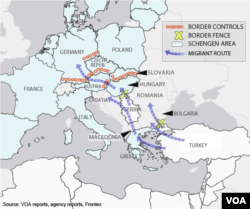
    Europe is struggling with the influx of migrants from the Middle East, especially Syria.  Many of them leave from Turkey and travel through the Balkans in an attempt to enter the 28-nation bloc.

    The European Union would offer billions in aid and concessions to Turkey in exchange for measures to stem the mass movement of migrants coming from Syria, Iraq and other war zones into Europe.

    Officials said the incentives offered to Turkey would involve an aid package of at least $3.4 billion to help Turkey host the more than 2 million refugees that are in the country, as well as easier access to EU visas for Turkish citizens and re-energized EU membership talks.

    Criticizes EU

    Merkel is due to meet later in the day with Turkey's President Recep Tayyip Erdogan. Erdogan has previously criticized Europe's efforts to deal with the crisis and urged Brussels to take Ankara's EU membership bid more seriously.

    "They announce they'll take in 30,000 to 40,000 refugees and then they are nominated for the Nobel for that," he said in a jab at Merkel, who had been tipped as a Nobel Peace Prize contender for her welcoming stance to refugees. "We are hosting 2.5 million refugees but nobody cares."

    Apart from the migrant crisis, the Turkish and German leaders will also discuss the fight against terrorism and the situation in Syria.
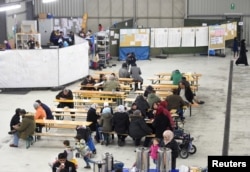
    Migrants sit in a canteen in a refugee camp in Celle, Lower-Saxony, Germany, Oct. 15, 2015.
    Migrants sit in a canteen in a refugee camp in Celle, Lower-Saxony, Germany, Oct. 15, 2015.

    Also Sunday, about 40 buses packed with migrants queued to enter Croatia from Serbia, their passage to Western Europe slowed by a new diversion through Slovenia as weather conditions worsen.

    Many had spent the night on the buses, wrapped in warm clothes and blankets against the autumn cold. They woke to dense fog.

    Hungary sealed its southern border with Croatia to migrants at midnight Friday, forcing them west to fellow EU member Slovenia, a small former Yugoslav republic of 2 million people that also borders Austria.

    About 3,000 entered Slovenia Saturday, en route to Austria and Germany, the favored destination of the vast majority, many of them Syrians fleeing war.

    But Slovenian authorities said they planned to limit the influx to around 2,500 per day in line with the country's capacity to register and accommodate them.

    Backlog threatened

    That threatened to create a backlog in Croatia and Serbia which in recent weeks have seen upwards of 5,000 crossing their borders every day.
    Croatian police said Sunday they blocked dozens of migrants seeking to cross from Serbia, anxious to continue their journey toward Western Europe.

    Migrants faced off with Croatian police in a corn field at the border between Serbia and Croatia where they have been crossing since mid-September. Tensions rose as the Croatian police deployed along the boundary to stop them.

    Backlog

    A spokesman for the United Nations refugee agency warned that Hungary's decision to close its border for migrants has increased their suffering and could lead to a backlog down the route.

    Babar Baloch, regional spokesman for Central Europe for the U.N. High Commissioner for Refugees, said the new migrant route through Slovenia has significantly prolonged their already weeks-long journey toward Western Europe.

    Baloch warned "there will be challenges if the process becomes slow or we have a backlog of people."

    Austrian police say that about 1,000 refugees and other migrants were registered on Saturday and overnight as they arrived at one of the country's main border crossings with Slovenia.
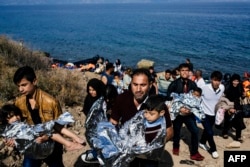
    Men carry their children wrapped in emergency blankets shortly after arriving with other migrants and refugees on the Greek island of Lesbos after crossing the Aegean sea from Turkey, Oct. 18, 2015.
    Men carry their children wrapped in emergency blankets shortly after arriving with other migrants and refugees on the Greek island of Lesbos after crossing the Aegean sea from Turkey, Oct. 18, 2015.

    More than 630,000 people fleeing war and misery in the Middle East and Africa have landed on Europe's shores this year, many making risky sea crossings from Turkey to Greece.

    Drownings

    Meanwhile, the Greek coast guard on Sunday said five more migrants including a baby and two boys had died trying to cross the Aegean Sea from neighboring Turkey.

    Most of the deaths occurred near the island of Kastellorizo, where an American-flagged sailing boat said it had rescued nearly a dozen people, with a dead infant among them.

    And on Saturday, another 12 people drowned off the Turkish coast, Anatolia news agency reported.

    The UN refugee agency UNHCR has reported an increase in the number of migrant boats arriving from Turkey this week.

    "The surge in arrivals could be the result of a temporary improvement in the weather, a rush to beat the onset of winter, and a fear that European borders may soon close," UNHCR said Friday.

    Dorian Jones contributed to this report from Istanbul. Some material for this report came from AFP, AP and Reuters.

    You May Like

    California Republicans Mull Choices in Presidential Race

    Ted Cruz tells state's Republican Convention delegates campaign will be 'battle on the ground, district by district by district,' ahead of June 7 primary

    Video Kurdish Football Team Helps War-Torn City Cope

    With conflict still raging across much of Turkey’s predominantly Kurdish southeast, many Kurds are trying to escape turmoil by focusing on success of football team Amedspor

    South African Company Designs Unique Solar Cooker

    Two-man team of solar power technologists introduces Sol4, hot plate that heats up so fast it’s like cooking with gas or electricity

    This forum has been closed.
    Comment Sorting
    Comments
         
    by: StevenW from: Germany
    October 19, 2015 5:33 PM
    So if EU gives visa liberation to the Turks or even (unrealistically) the EU membership to Turkey, the EU will get 80 Million Muslim Turks + 2 Million Muslim refugees that are already in Turkey.

    If EU doesn't give anything to Turkey, the EU will get a max of 1 Million Muslim refugees.

    The choice is obvious: Tell Turkey to go away.
    In Response

    by: Peter Brownp
    October 20, 2015 5:48 AM
    The choice is even more obvious. Modern European Navies have the ability to detect and turn back migrant boats to their point of departure instead of actually assisting them. The naval ships in the Mediterranean were acting like nothing more than passenger ferries from just outside of Libyan territorial waters all the way across to Europe. Anyone looking from the outside could see that this was not a humanitarian policy, it was a deliberate attempt to bring in cheap labour to Europe and to dissolve the National heritage of European Countries.

    Merkel and the EU in their naive pursuit of a Federalized Europe, miscalculated the reaction of the Member States to this invasion including her own. No economy or culture can withstand such a massive influx in such a short time. Unless Merkel and the EU stop this nonsensical policy of 'open door', they risk the breakup of the EU altogether. If Germany has a genuine need of migrants then let them come from source in the refugee camps after careful vetting. Germany certainly doesn't need to make up its shortfall IMMEDIATELY. It can make up its shortfall over a controlled period and allow some of it to be taken up by migrant birth.

    It would be the gravest mistake of the lot to allow Turkey to accede to the EU. It is, in any case, 95% Asian, not European and is becoming progressively non-secular. Europe will not survive the accession as a culture and it behoves Europeans to warn the EU that it cannot change that for its own selfish ends.

    by: Peter Brownp
    October 19, 2015 12:42 PM
    The sort of help that Merkel wants from Erdogan is not to stem the flow of migrants into Europe, it is to increase it.

    She and the EU went far further than was required by the UN policy on immigration and asylum. The UN, rightly, says that Asylum Seekers must be allowed in but 'Economic migrants' are not covered by the Geneva accord. However, the EU has deliberately encouraged ALL migrants to enter the EU. In fact, legally, none of the migrants coming through Turkey and Libya are refugees as they have all passed through at least one 'safe' country before they even attempt the sea crossing.

    Now that Merkel is receiving a backlash, even from the Germans, for the numbers of people arriving; both she and President Schulz have been to Turkey to offer help in Turkey's accession to the EU even though previously, Turkey had been turned down because of i ts appalling human rights record. If anything, its behaviour has worsened yet the EU see this as a way of getting around the protestations of the People by offering the fait accompli of Turkey being a member of the EU and having an automatic right for its 77 million population plus the 2 - 3 million Syrians already there to have full access to the EU. That is not to even mention Turkey's porous borders to most of the Middle Eastern trouble spots that will open the whole Middle East to Europe.

    Their motive is pure Corporate greed to flood Europe with a cheap compliant workforce and they do not care that they are wiping out centuries of culture and national pride. It is Treason of the worst kind.

    by: Putch from: Ebunovo, Tyumen
    October 19, 2015 6:08 AM
    This UPSHOT

    by: Bruce from: Canada
    October 18, 2015 7:38 PM
    It is a mistake for Germany to offer to support Turkey's faster track into the European Union on condition that Ankara helps alleviate Europe's growing immigration crisis. Accession of Turkey to the EU would pave the way for unlimited Muslim migration which is the last thing that Europe needs, struggling as it with Muslim immigration many EU members of which want to protect their traditional if Christian values. Turkey under Erdogan is no longer a secular state and seems determined to push an Islamic agenda. Merkel seems determined to compound error with felony in first inviting 800,000 Islamic refugees and migrants into Germany and now offering to open the floodgates of future Islamic immigration in a vain attempt to stop the current flow.

    by: Victor from: Canada
    October 18, 2015 7:04 PM
    So German Chancellor Angela Merkel thinks inviting 80 million Turkish Muslims to move into Europe is a good idea! Unbelievably short sighted and worthy of a Nobel Prize for foolishness.
    In Response

    by: Peter Brownp
    October 19, 2015 12:45 PM
    They already have the Nobel Prize. Laughably, Europe was offered the 'Peace' prize. The year after Obama was given one after just one year in Office. The Nobel Institute has thoroughly debased the award.

    by: Marcus Aurelius II from: NJ USA
    October 18, 2015 4:02 PM
    Mrs. Merckel, your government shelled out hundreds of billions of Euros to Greece to rescue it from its own corruption, deceit, and incompetence in handling its financial affairs. Your country has contributed almost nothing to NATO relying on others to defend Germany, what's in this for Turkey? Why should they make any sacrifice to the EU which told them they couldn't join because they are not part of Europe while at the same time you went to the US to try to persuade President Bush that America should join the EU?

    You'll just have to do a lot better than throw Turkey a few small crumbs if you want its cooperation. Now how many hundreds of billions have your government and the banksters who run Deutschebank and the other corrupt enterprises like VW got stashed away for a rainy day? Looks like dark clouds headed your way. Nope, not clouds, swarms.
    In Response

    by: Marcus Aurelius II from: NJ USA
    October 21, 2015 3:16 PM
    Anonymous, so that's it then. Turkey can send all of its refugees to Germany.

    What has Germany or anyone in the EU done for Turkey that would cause Turkey to give its cooperation and bail the EU out? None that I can think of. So you don't want to pay Turkey to take part of the problem off your hands. Do you want them all at once or would say 100,000 an week for five months be okay?
    In Response

    by: Anonymous from: Germany
    October 21, 2015 12:14 PM
    @Marcus Aurelius II It's better to get 2Million Syrian Refugees and be done with it than to get 2Million Syrian Refugees + 80Million Muslim Turks
    In Response

    by: Marcus Aurelius II from: NJ USA
    October 20, 2015 8:41 PM
    Well if that's what it took to get them into the EU then it worked. That's Angela Merckel's reward to them. But what if they no longer want to join the EU? Better plan on working to age 75. I have a hunch Germany will have to shell out another 500 billion to a trillion Euros. It's that or get flooded by more Syrian refugees. Turkey has about 2 million of them to send you.
    In Response

    by: HansF from: Germany
    October 19, 2015 6:34 PM
    Because Turkey created this mess by supporting ISIS and AQ Groups.
    Turkey = ISIS

    Featured Videos

    Your JavaScript is turned off or you have an old version of Adobe's Flash Player. Get the latest Flash player.
    Turkish Kurd Islamist Rally Stokes Tensionsi
    X
    April 29, 2016 12:28 AM
    In a sign of the rising power of Islamists in Turkey, more than 100,000 people recently gathered in Diyarbakir, the main city in Turkey’s predominantly Kurdish southeast, to mark the birthday of the Prophet Muhammad. The gathering highlighted tensions with the pro-secular Kurdish nationalist movement. Dorian Jones reports from Diyarbakir.
    Video

    Video Turkish Kurd Islamist Rally Stokes Tensions

    In a sign of the rising power of Islamists in Turkey, more than 100,000 people recently gathered in Diyarbakir, the main city in Turkey’s predominantly Kurdish southeast, to mark the birthday of the Prophet Muhammad. The gathering highlighted tensions with the pro-secular Kurdish nationalist movement. Dorian Jones reports from Diyarbakir.
    Video

    Video Pakistani School Helps Slum Kids

    Master Mohammad Ayub runs a makeshift school in a public park in Islamabad. Thousands of poor children have benefited from his services over the years, but, as VOA's Ayesha Tanzeem reports, roughly 25 million school-age youths don't get an education in Pakistan.
    Video

    Video Florida’s Weeki Wachee ‘Mermaids’ Make a Splash

    Since 1947, ‘mermaids’ have fascinated tourists at central Florida’s Weeki Wachee Springs State Park with their fluid movements and synchronized ballet. Performing underwater has its challenges, including cold temperatures and a steady current, as VOA’s Lin Yang and Joseph Mok report.
    Video

    Video Somali, African Union Forces Face Resurgent Al-Shabab

    The Islamic State terror group claimed its first attack in Somalia earlier this week, though the claim has not been verified by forces on the ground. Meanwhile, al-Shabab militants have stepped up their attacks as Somalia prepares for elections later this year. Henry Ridgwell reports there are growing frustrations among Somalia’s Western backers over the country’s slow progress in forming its own armed forces to establish security after 25 years of chaos.
    Video

    Video Bangladesh Targeted Killings Spark Wave of Fear

    People in Bangladesh’s capital are expressing deep concern over the brutal attacks that have killed secular blogger, and most recently a gay rights activist and an employee of the U.S. embassy. Xulhaz Mannan, an embassy protocol officer and the editor of the country’s only gay and transgender magazine Roopban; and his friend Mehboob Rabbi Tanoy, a gay rights activist, were hacked to death by five attackers in Mannan’s Dhaka home earlier this month.
    Video

    Video Documentary Tells Tale of Chernobyl Returnees

    Ukraine this week is marking the 30th anniversary of the world's worst nuclear accident, at the Chernobyl nuclear power plant. Soviet officials at first said little about the accident, but later evacuated a 2,600-square-kilometer "exclusion zone." Some people, though, came back. American directors Holly Morris and Anne Bogart created a documentary about this faithful and brave community. VOA's Tetiana Kharchenko reports from New York on "The Babushkas of Chernobyl." Carol Pearson narrates.
    Video

    Video Nigerians Feel Bite of Buhari Economic Policy

    Despite the global drop in the price of oil, Nigerian President Muhammadu Buhari has refused to allow the country's currency to devalue, leading to a shortage of foreign exchange. Chris Stein reports from Lagos businessmen and consumers are feeling the impact as the country deals with a severe fuel shortage.
    Video

    Video  Return to the Wild

    There’s a growing trend in the United States to let old or underused golf courses revert back to nature. But as Erika Celeste reports from one parcel in Grafton, Ohio, converting 39 hectares of land back to green space is a lot more complicated than just not mowing the fairway.
    Video

    Video West Urges Unity in Libya as Migrant Numbers Soar

    The Italian government says a NATO-led mission aimed at stemming the flow of migrants from Libya to Europe could be up and running by July. There are concerns that the number of migrants could soar as the route through Greece and the Balkans remains blocked. Western powers say the political chaos in Libya is being exploited by people smugglers — and they are pressuring rival groups to come together under the new unity government. VOA's Henry Ridgwell reports.
    Video

    Video Russia’s TV Rain Swims Against Tide in Sea of Kremlin Propaganda

    Russia’s media freedoms have been gradually eroded under President Vladimir Putin as his government has increased state ownership, influence, and restrictions on critical reporting. Television, where most Russians get their news, has been the main target and is now almost completely state controlled. But in the Russian capital, TV Rain stands out as an island in a sea of Kremlin propaganda.

    Special Report

    Adrift The Invisible African Diaspora