


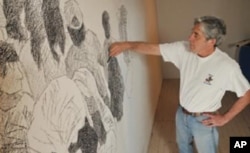
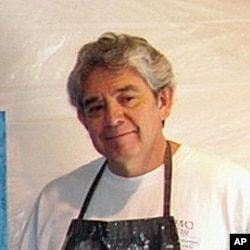
The Latino experience is a common theme for Mexican-American artist Tony Ortega. His work often examines the overlooked contributions of people - especially immigrants - who do manual labor.
An exhibit of of Ortega's work in Boulder, Colorado, is prompting conversations about the U.S. Mexico border, and those who cross it.
Life in the shadows
When Ortega talks about his art with museum visitors, he sometimes asks them to choose their favorite. Especially when those visitors are young.
The boys in one group all have parents who are immigrants from Mexico. In Ortega's exhibit at the Boulder Museum of Contemporary Art, they see plenty of familiar images. Ortega - who works in charcoal, silkscreen and colored etchings - has drawn a maid tidying a hotel bed, a carpenter hammering a roof. Ortega asks the boys what kind of work their parents do.
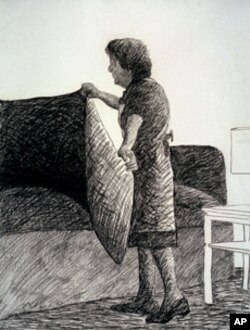
"The same thing of the painting," says one. "My dad makes bread and my mom cleans houses."
"Yeah," adds his companion. "My grandmother who raised me cleaned houses also."
Ortega's grandmother encouraged him to go to college, the first in his family to do so. Her efforts to support the family helped him view laborers - especially immigrant workers - with a sympathetic eye.
"What I'm trying to do with the work is to try to make an invisible part of the population, people who take care of our kids, who clean our streets and our houses, who pick our crops, more visible," says Ortega. "I think they make major contributions, but they're in the shadows."
Shedding light
Art can help bring them out of the shadows, says Rich Lopez, a Denver attorney touring the exhibit.
"I've been a fan of Tony Ortega for many years. He's captured the essence of the Chicano Mexican American experience in his art for years and years, and his colors and images are quite memorable. The mechanic looks like my cousin."

Images like that mechanic have earned Ortega a showing in galleries and museums throughout the United States. He's also become a sought-after teacher, at Denver's Regis University and through visiting artist programs. For a recent project, Ortega enlisted children to help him create a wall-sized mural about their neighborhood.
"One little boy, at the end of the week, he says, 'Have we learned all the techniques that you can learn about painting?' I says, 'Well, there's not enough time in a week.' And he says 'Well, I want to learn all of those."
Exploring the immigrant experience
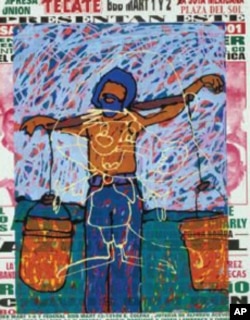
At the museum exhibit, Ortega asks the boys which picture to talk about next. They choose one full of electric-bright, scribbled images. Superimposed on those is the outline of a famous cartoon mouse. Not Mickey. It's Speedy Gonzales, a Mexican-American mouse, who always saves other mice from Sylvester the Cat.
"To me, Speedy's always helping the Mexicans. He's always saving his buddies against the gringo gato because Sylvester wants to eat him," Ortega tells the laughing boys.
Then he points out that - behind his ghostly outline of Speedy - is a man who carries water buckets, suspended from a wooden yoke across his shoulders. The man's legs look long and narrow while his arms, draped over the yoke, stretch wide.
"What is this guy doing? Is he like a Christ figure?" Ortega asks the boys.
The boys study Ortega's image of a laborer as a martyr, and discuss how hard work and sacrifice do not necessarily guarantee a warm welcome in America. There is more religious imagery in another piece on display.
It's an image of the Statue of Liberty. But not the green-robed Liberty with her proud, green face. Ortega's Liberty wears the blue robes of Mexico's beloved Virgin of Guadalupe, and her brown face looks kind.
The boys praise Ortega's exhibit. For some, this is a first ever visit to an art museum.
"People, Mexican people in the paintings that he does," says one. "They're all awesome."
His friend agrees. "He showed me how life could be for Mexicans, and that sometimes it could be sad, but sometimes it could have a great life."
Ortega was honored with the Colorado Governor's Award for Excellence in the Arts for his work inspiring people to see the beauty and challenges of hidden lives.
His exhibit at the Boulder Museum of Contemporary Art is called, "Mi Frontera es Su Frontera," which means, "My Border is Your Border."