Morsi, Middle East Take Center Stage at UN General Assembly
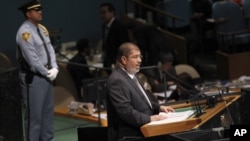
Mohammed Morsi, President of Egypt, addresses the 67th session of the United Nations General Assembly at U.N. headquarters, Wednesday, Sept. 26, 2012.
UNITED NATIONS —
At the United Nations General Assembly, Egypt's new president made his debut Wednesday, while Iran's president gave his final speech to the annual gathering. Away from the podium, leaders discussed crises in the Sahel, Somalia and Middle East.
Egypt's new president, Mohamed Morsi, introduced himself as his country's first civilian president elected democratically following a peaceful revolution. He laid out the new Egypt's vision on issues in the Middle East and Africa and denounced a recent video that mocked Islam.
He said the most important issue facing the international community is the need to resolve the Israeli-Palestinian conflict. "I call upon you all, just as you have supported the revolutions of the Arab peoples, I call upon you to lend your support to the Palestinians in their endeavor to regain the full and legitimate rights of a people struggling to gain its freedom and establish his independent state," he said.
On the crisis in Syria, President Morsi said the bloodshed must end and the humanitarian crisis stop. He urged the opposition to propose a unified vision of a democratic transfer of power and said the time would soon come for the Syrian people to decide their destiny.
"After this regime - the current regime - comes to an end -- the regime that kills its people day and night - after this regime comes to an end, the Syrian people will choose, with their own freewill, a regime that represents it and places Syria in its right place among democratic countries," he said.
Iranian President Mahmoud Ahmadinejad also spoke Wednesday. In his eighth and final appearance at the annual gathering, he struck a more sedate tone, giving his ideas about a new world order and mostly refraining from his usual vitriol about the United States and Israel.
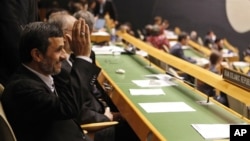
Iranian President Mahmoud Ahmadinejad gestures as he arrives at his seat before addressing the 67th session of the UN General Assembly at UN. headquarters in New York, September 26, 2012.
He made only one vague reference to his country’s problems with the international community over its controversial nuclear program. He is heard here through an interpreter: "Continued threat by the uncivilized Zionists to resort to military action against our great nation is a clear example of this bitter reality," he said.
The United States said it did not send a representative to hear Ahmadinejad’s speech because he had used his U.N. trip to "spout paranoid theories and repulsive slurs against Israel." Wednesday was also the Jewish holy day of Yom Kippur.
British Prime Minister David Cameron used his time at the podium to urge support for the Arab Spring. "The Arab Spring represents a precious opportunity for people to realize their aspirations for a job, a voice and a stake in their own future," he said.
Away from the podium, the U.N. Security Council held a high-level meeting with the Arab League on how the two bodies could improve cooperation. Syria and the stalled Israeli-Palestinian peace process figured prominently among their remarks.
There were also high-level meetings to discuss the political transition in Somalia and the crisis in the Sahel. The United States and France urged the United Nations to support an African-led peacekeeping force to restore stability in northern Mali.
The annual meeting continues Thursday with an address from Burma's civilian president, Thein Sein, and speeches from the leaders of Israel and the Palestinian Authority, among others. Outside the General Assembly, there will be a meeting of world powers on Iran's nuclear program.
Watch related video of presidents of Pakistan, Afghanistan at UN
Some information for this report was provided by AP, AFP and Reuters.