

President Barack Obama’s announcement of a gradual drawdown of American forces in Afghanistan is getting mixed reviews from U.S. lawmakers. Reaction from Republican and Democratic leaders is generally positive, but many rank-and-file members of both parties say they are dissatisfied - for widely divergent reasons.
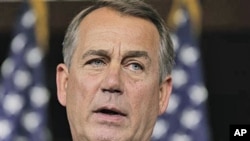
It is not often that the top Republican on Capitol Hill, House Speaker John Boehner, and Democratic Minority Leader Nancy Pelosi agree on anything. But both gave cautious endorsements of the president’s timetable for winding down the war in Afghanistan.
Speaker Boehner stressed that he does not want to see progress in Afghanistan jeopardized, but added the following.
“As I understand it, the top brass at the Pentagon are comfortable with the president’s strategy," said Boehner. "And I have said since the president took office that if the president listened to his commanders and his diplomats in the region, that I would support his plan. I am generally supportive of the plan, because there is enough flexibility in the withdrawal to take into consideration conditions on the ground [in Afghanistan].
Representative Pelosi expressed hope troops can be brought home faster than Obama envisions. But she, too, endorsed the president's announcement.
“The good news is the president is bringing the war in Afghanistan to an end," she said. "The president, for his reasons, has the timetable he has. I respect that.
Obama’s timetable for withdrawing troops does not satisfy ardent critics of the war in Afghanistan. Democratic Congressmen Peter DeFazio of Oregon and Keith Ellison of Minnesota say they are disappointed.
“Twelve to 36 more months of a large U.S. troop footprint is not going to resolve centuries-old conflicts among the Afghan tribes," said DeFazio. "So I disagree with the President’s plan for a snail’s pace, partial drawdown of U.S. troops.”
“The announcement of troop reductions was welcome, but not nearly ambitious enough," said Ellison. "The president outlined a strategy for reducing the [troop] surge. And I have to believe that we can do much better than removing all the surge troops in 15 months.”
At the other end of the spectrum are Republican lawmakers who oppose any cuts in troop strength, so long as the security situation in Afghanistan remains perilous.
House Armed Services Committee Chairman Buck McKeon said, “I am deeply concerned about the aggressive troop withdrawal proposed by President Obama. The president’s decision could jeopardize the hard-won gains our troops and allies have made over the past 18 months and, potentially, the safety of the remaining forces. This announcement also puts at risk a negotiated settlement with reconcilable elements of the Taliban, who will now believe they can wait out the departure of U.S. forces.”
McKeon spoke at a hearing featuring testimony by the Chairman of the Joint Chiefs of Staff, Admiral Mike Mullen, who admitted to having initial misgivings about the president’s withdrawal strategy, and stressed that no troop reduction is without risk. But he added that he fully supports the president’s decision.
“There is no jumping ship [no abandoning the mission] here. Quite the contrary, we will have at our disposal the great bulk of the surge forces through this and most of the next fighting season,” said Mullen.
Congress overwhelmingly endorsed then-president George W. Bush’s decision to invade Afghanistan after the 2001 terrorist attacks on the United States. Nearly 10 years later, the American public has soured on the war, as have many legislators. But Congress has consistently funded the U.S. mission in Afghanistan, and shows no inclination to halt that funding or interfere with the president’s conduct of the war.
Mixed Congressional Reaction to Obama Afghanistan Plan