


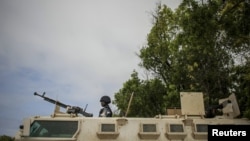
MOGADISHU — Today whoever visits Somalia's capital will tell you how significantly security has improved in the city. Ordinary Somalis don’t have to face the constant street fighting they endured during the last two decades. But those involved in the process of bringing stable institutions and government to the war-torn country still face an element of danger. Targeted killings in the city are on the rise.
General security has improved in Mogadishu, but journalists, aid workers, and people working for government institutions still face threats to their lives.
Eight journalists and media professionals have been killed in Somalia this year, and suicide bombers tried unsuccessfully to attack the meeting where Somalia's new constitution was passed earlier this month.
The U.S. envoy to Somalia, Ambassador James Swan, praised individuals working with the government despite daily threats against them.
“Let me just say we are very much impressed at the courageousness, not only for media organs but also for example members of the technical selection committee and other involved in this transition process," said Dwan. "They have shown courage, great integrity, a genuine commitment to change here in Somalia.”
The technical selection committee that Swan mentions is working to screen and approve members of Somalia's new parliament. The committee recently rejected more than 60 nominated legislators because of their connection to and involvement in Somalia’s civil war.
This step has angered many warlords in the city and residents fear war may break out between warlords' militias and the African Union (AU) peacekeeping force, known as AMISOM.
Mogadishu has enjoyed a year of peace since AU troops along with Somali government forces drove the militant group al-Shabab out of the city last year.
The threat of street violence has not disappeared entirely. Nearly every street and alley in Mogadishu has a checkpoint administered by clan-based militias who portray themselves as official police.
Informed sources familiar with these checkpoints tell VOA that payment is made to the commander of each checkpoint, and depending how frequently one uses these checkpoints, drivers can pay up to $20 a day or about $200 monthly.
For militiamen manning these checkpoints, it is the only way they can earn a living.
Ambassador Swan said the security forces in the country, both African Union and Somali government forces, must provide a more secure environment for individuals and institutions affiliated with the country’s transition process.
The United Nations special representative for Somalia, Augustine Mahiga, warned no one will be allowed to disturb the relative peace which the country has enjoyed for the last year.
“The force commander of AMISOM, he has given assurance to the international partners and to the process that AMISOM is fully equipped, is fully alert, is on top of the situation and we do not expect the peace that has been won so dearly to be disturbed," said Mahiga.
The peace will be tested in the coming days as the final members of the new parliament are selected and lawmakers then elect a new president. The United Nations hopes the process will give Somalia its first stable central government in more than two decades.
General security has improved in Mogadishu, but journalists, aid workers, and people working for government institutions still face threats to their lives.
Eight journalists and media professionals have been killed in Somalia this year, and suicide bombers tried unsuccessfully to attack the meeting where Somalia's new constitution was passed earlier this month.
The U.S. envoy to Somalia, Ambassador James Swan, praised individuals working with the government despite daily threats against them.
“Let me just say we are very much impressed at the courageousness, not only for media organs but also for example members of the technical selection committee and other involved in this transition process," said Dwan. "They have shown courage, great integrity, a genuine commitment to change here in Somalia.”
The technical selection committee that Swan mentions is working to screen and approve members of Somalia's new parliament. The committee recently rejected more than 60 nominated legislators because of their connection to and involvement in Somalia’s civil war.
This step has angered many warlords in the city and residents fear war may break out between warlords' militias and the African Union (AU) peacekeeping force, known as AMISOM.
Mogadishu has enjoyed a year of peace since AU troops along with Somali government forces drove the militant group al-Shabab out of the city last year.
The threat of street violence has not disappeared entirely. Nearly every street and alley in Mogadishu has a checkpoint administered by clan-based militias who portray themselves as official police.
Informed sources familiar with these checkpoints tell VOA that payment is made to the commander of each checkpoint, and depending how frequently one uses these checkpoints, drivers can pay up to $20 a day or about $200 monthly.
For militiamen manning these checkpoints, it is the only way they can earn a living.
Ambassador Swan said the security forces in the country, both African Union and Somali government forces, must provide a more secure environment for individuals and institutions affiliated with the country’s transition process.
The United Nations special representative for Somalia, Augustine Mahiga, warned no one will be allowed to disturb the relative peace which the country has enjoyed for the last year.
“The force commander of AMISOM, he has given assurance to the international partners and to the process that AMISOM is fully equipped, is fully alert, is on top of the situation and we do not expect the peace that has been won so dearly to be disturbed," said Mahiga.
The peace will be tested in the coming days as the final members of the new parliament are selected and lawmakers then elect a new president. The United Nations hopes the process will give Somalia its first stable central government in more than two decades.