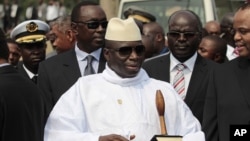
There are now conflicting accounts whether authorities in The Gambia have executed nine prisoners, as reported by Amnesty International.
Amnesty said Friday that according to "reliable sources," nine death-row inmates were taken from their cells the night before and executed.
A group called the Civil Society Associations of Gambia says on its website that it confirmed the executions, and that on Friday morning the bodies were seen lying in the yard of the Mile Two Central Prison.
However, the president of a rights group in neighboring Senegal tells says that "so far, nobody was executed."
Alioune Tine, president of the African Assembly for the Defense of Human Rights, says his information comes from Gambian opposition members and journalists and the foreign ministers of The Gambia and Benin.
A Gambian government statement late Friday defended the country's death-penalty laws, but neither confirmed nor denied any executions had taken place.
If confirmed, the executions would be first in the tiny West African nation in more than a quarter-century.
President Yahya Jammeh said earlier this week that he will ensure that the death penalty is "carried out to the letter" by mid-September for all condemned prisoners.
Government officials have confirmed the president's statement, but have not discussed any individual cases. Before Thursday, it was believed that Gambian courts had handed down death sentences for 47 imprisoned men and women - many of whom had been charged with treason.
Amnesty International is appealing to Jammeh to reverse the "giant leap backwards" he took by ordering the execution of all prisoners already sentenced to death.
News reports say the African Union and Britain also urged Jammeh to call off the executions. Without responding directly, authorities in Banjul have stressed that all condemned prisoners have already exhausted their judicial rights of appeal.
One account said two of those executed were Senegalese.
The Gambia is a small sliver of land surrounded by Senegal, except where the Gambia River empties into the Atlantic Ocean near Banjul, the capital.
President Jammeh has ruled the country since seizing power in military coup in 1994. His administration has been accused of many human-rights abuses.
The Gambia outlawed capital punishment decades ago, but Jammeh reinstated the death penalty in 1995. However, there had been no reports of executions until now.
Amnesty said Friday that according to "reliable sources," nine death-row inmates were taken from their cells the night before and executed.
A group called the Civil Society Associations of Gambia says on its website that it confirmed the executions, and that on Friday morning the bodies were seen lying in the yard of the Mile Two Central Prison.
However, the president of a rights group in neighboring Senegal tells says that "so far, nobody was executed."
Alioune Tine, president of the African Assembly for the Defense of Human Rights, says his information comes from Gambian opposition members and journalists and the foreign ministers of The Gambia and Benin.
A Gambian government statement late Friday defended the country's death-penalty laws, but neither confirmed nor denied any executions had taken place.
If confirmed, the executions would be first in the tiny West African nation in more than a quarter-century.
President Yahya Jammeh said earlier this week that he will ensure that the death penalty is "carried out to the letter" by mid-September for all condemned prisoners.
Government officials have confirmed the president's statement, but have not discussed any individual cases. Before Thursday, it was believed that Gambian courts had handed down death sentences for 47 imprisoned men and women - many of whom had been charged with treason.
Amnesty International is appealing to Jammeh to reverse the "giant leap backwards" he took by ordering the execution of all prisoners already sentenced to death.
News reports say the African Union and Britain also urged Jammeh to call off the executions. Without responding directly, authorities in Banjul have stressed that all condemned prisoners have already exhausted their judicial rights of appeal.
One account said two of those executed were Senegalese.
The Gambia is a small sliver of land surrounded by Senegal, except where the Gambia River empties into the Atlantic Ocean near Banjul, the capital.
President Jammeh has ruled the country since seizing power in military coup in 1994. His administration has been accused of many human-rights abuses.
The Gambia outlawed capital punishment decades ago, but Jammeh reinstated the death penalty in 1995. However, there had been no reports of executions until now.
Some information for this report was provided by AP, AFP and Reuters.