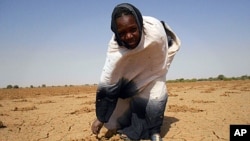
The International Federation of Red Cross and Red Crescent Societies says more than one million Mauritanians could face hunger in the New Year unless immediate action is taken.
Mauritania is suffering from the combined effects of drought, poor harvests and rising food prices, making life extremely difficult for tens of thousands of people who cannot afford to buy what little food is available on the market.
The International Red Cross Federation predicts the number of people likely to face food shortages could reach 1.2 million in January, the first month of the New Year.
Red Cross spokeswoman Jessica Sallabank says immediate steps must be taken to prevent, what could become, a hunger crisis equal to that in the devastated Horn of Africa.
She says the Red Cross needs to raise more than $2 million to quickly get as much food as possible in place to head off the crisis threatening Mauritania.
“The money raised is aimed to assist over 10,000 households, 10,000 families," said Sallabank. "And priority spending for these funds will be again fodder for livestock, to provide seeds and tools for farmers, people living in rural communities, to provide food relief to people who do not have enough food, and also help to maintain and support the nutrition centers that exist already in the country.”
The Red Cross Federation says it is concerned in particular about malnutrition rates for children under two years of age. It notes the southern Mauritanian regions of Brakna and Gorgol have the highest acute malnutrition rates in the country.
Sallabank says a priority for the Mauritanian Red Crescent is to provide badly malnourished children with life-saving supplementary nutrition, such as rice and cereals.
She says in an effort to prevent recurring food crises, the Red Cross plans to implement activities to help make people less dependent on rainwater for their food security.
“These programs for example include investing in different irrigation systems for crops. So, for example, training or introducing drip-feed systems into rural communities, which enable crops to be watered more consistently and for a longer period of time, even in times of drought," she said. "Also, another way in which we could really help people better withstand the shock of drought is by digging deep water wells. The Mauritanian Red Crescent staff and the volunteers are out in the communities and they are digging much deeper water wells in villages, which obviously their families can still access water in times of severe drought.”
Red Cross officials say a new tragedy could be avoided in Mauritania if the international community responds to the needs immediately, and action is taken now.
More Than One Million Mauritanians Face Hunger in 2012
- By Lisa Schlein