



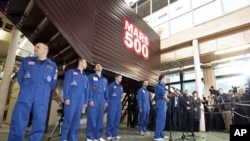
After a year and a half, six crew members are now free from an isolation module in Moscow. The members were kept away from the world in an attempt to simulate the effects of a return voyage to Mars.
A Russian official broke the red seal on the space capsule allowing the first weary, pale, crew member to emerge into the real world.
Wearing a blue jumpsuit and blinking, Commander Alexei Sityov appeared a little wobbly, but smiling as he addressed a press conference, saying that the "international crew has completed the 520-day mission."
Sityov said, "The program has been fully carried out. All the crew members are in good health."
Columbian-Italian crew member Diego Urbina, who wants to eventually work in space research, couldn’t stop smiling as he addressed the crowd.
"It’s been an honor to have been part of this remarkable achievement, five of the most professional, friendly and resilient individuals that I have worked with," said Urbina."I will be forever thankful for all of those who stood close to me during this long odyssey."
Chinese crewmember Wand Yue seemed more than relieved to be set free, saying only that "after 520 days, we are finally back."
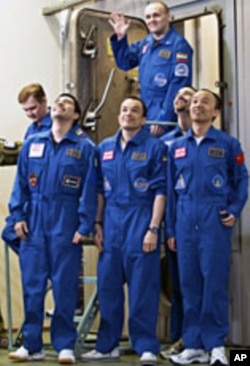
Participants were locked away in the makeshift space capsule with no windows for almost one and a half years; their only contact with the outside world was through e-mail.
The capsule included medical, sleeping, landing, storage and surface modules with a total interior space of only 550 cubic meters.
All of the capsules, except for one, were used for living and working. The interior was decorated with wood paneling, furniture and rugs in an attempt to make the experience more like home.
There was even one module that was meant to appear just like the red planet, complete with rocks, and sand. This is where the volunteers performed space walks.
Russian cosmonaut Gennady Padalka says the experiment conditions were as close to real as it gets, especially since the volunteers were from several different countries including Russia, China and Colombia. He says the "main thing was that the module created a good psychological climate."
Addressing the issue on state television, Padalka added that the last time he went to space "there was a real symbiosis because everyone had their own traditions and customs. But the best thing is to find something useful that unites people."
Alan Smith, a professor with the Mullard Space Science Laboratory in London, also praised the project, saying the technology is available to send people on the long trek, but there hasn't been enough research on the psychological feasibility of the journey to Mars and back.
"The most focus so far has been the technology that gets you to Mars and lands you on Mars," said Smith. "And we can’t simulate it in one day. So one of the real problems of going to Mars is getting people to get on with each other for that period of time and still be effective."
No word yet on how the six volunteers got along. The group was whisked away for medical testing right after they addressed the crowd gathered to watch their return.
The crew will be in isolation until November 8. Maybe then we’ll find out how things went or didn’t.