



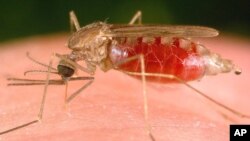
A new malaria prevention strategy might literally be blowing in the wind.
A team of scientists studying the patterns of malaria infection in rural Kenyan villages noticed that, despite a gradual reduction of malaria cases in the region, “hotspots” persisted.
The blood-sucking mosquitos that transmit the malaria parasite to humans breed in water.
So the researchers decided to examine the location of those breeding ponds in relation to the most infected villages. Their findings are published this week in Nature Communications.
Co-author David Smith, an epidemiologist with the Johns Hopkins Bloomberg School of Public Health in Baltimore, Maryland, says a curious pattern emerged.
“In this study what we did is we looked at the locations of aquatic habitats and the locations of humans and we were trying to find out if there was some kind of clustering, which there should be and of course there was. But as we looked even closer what we found was that there was an association between the direction of the wind and the location of where people were at risk.”
Smith says while mosquitos aren’t particularly good flyers, their flight pattern is directed by the scent of a potential human host.

“We had a hypothesis that since scents travel down wind, that the mosquitos were actually tacking across the wind until they found one of those odor plumes and then tacking upwind until they found it. We should expect to find that places with higher risk were upwind of larval habitat.”
Smith and his research team studied 642 children living in Kenyan villages after the rainy season, when malaria peaks.
Janet Midega is a medical entomologist with the Kenya Medical Research Institute and co-author of the study. She says scientists compared the malaria case data with the proximity of stagnant water pools. “What we did find was a lot of the pools of water did have immature mosquito stages, and so we sampled these pools of water. We sampled these mosquitos and identified them as the mosquito species that is responsible for malaria transmission in the area.”
The study found that the shorter the distance from those larval incubators, the higher the prevalence of malaria.
Smith says factoring wind into the equation makes it possible to target larval pools downwind from malaria hotspots and so control the disease at its source.
“And the philosophy here is just that knowing it better we might be able to predict the distribution of risk a little bit better, or at least understand what mosquitos are doing so that we can do a better job of distributing nets or interventions.”
Co-author Janet Midega says while plans are already underway to expand the study in Kenya, replicating it elsewhere presents an obvious challenge.
“The applicability of the outcome of these results will be extremely dependent on the local conditions and the mosquitos that are common in that local environment so that control measures are tailored for the local epidemiological situation.”
So, Midega says, prevention strategies will depend on where you live, as some 30 to 40 different mosquito species transmit malaria. Almost half the world’s population - about 3.3 billion people - is at risk. In fact, the mosquito-borne parasitic disease strikes some 250 million people every year, and results in nearly one million deaths, largely in sub-Saharan Africa.