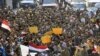



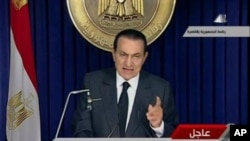
After a speech Thursday in which President Hosni Mubarak said he would stay as President, anti-government demonstrators ramped up their protests, surrounding government buildings in Cairo and elsewhere. On Friday, tension continued to mount. In the evening Cairo time, Vice President Omar Suleiman delivered the news the protesters had been waiting for. Suleiman announced President Mubarak had stepped down.
Hosni Mubarak's presidency was born during one of the most terrifying events in Egypt's history: the assassination of then President Anwar Sadat, at a military parade in 1981. Mr. Hosni Mubarak was vice president and escaped unscathed. The assassins were Islamic extremists in the army.
"I was in the stands when Sadat was assassinated, watched Mubarak get out from a pile of chairs, shake the dirt off his hat and was totally stunned by what had just happened," recalled David Ottaway who was Washington Post Bureau Chief in Cairo at the time.
Mr. Mubarak was sworn in as president eight days later. Ottaway describes him as stubborn and says he never really seemed interested in building a relationship with foreign media.
"He was always taciturn," said Ottaway. "His answers were somewhat cryptic and you quite didn't know what he meant when he spoke. He offered no real vision other than stability for his country."
Fast forward 30 years. For most of those years Egypt was stable. Cairo played an important role in maintaining an Egyptian-Israeli peace treaty that was unpopular with Egyptians and other Arab countries.
Egypt was eventually accepted back in the Arab fold. The Mubarak government worked to advance the Israeli-Palestinian peace process. It was a close ally of the United States.
But many say stability came at a high price. Prominent voices were imprisoned for criticizing Mr. Mubarak. Despite heavy security, the president was the target of several assassination attempts.
In the most recent parliamentary elections, the president's National Democratic Party crushed the opposition amid credible allegations of voter intimidation and vote rigging. Leaders of the Muslim Brotherhood, the most popular opposition movement, faced constant arrest and extended detentions.
Recently, Mr. Mubarak's apparent grooming of his son Gamal as his successor drew resentment from average Egyptians. And economic reforms widened the gap between rich and poor, according to Ottaway, now at the Woodrow Wilson Center.
"Economically, the reforms they began in 2004 produced tremendous results because the GDP of Egypt more than doubled in four years between 2004 and 2008," Ottaway noted. "So the economy was booming, but the people at the bottom were not benefitting from the economic boom. That's the background to the turmoil taking place now."
Then came Tunisia, and the revolt there. Egyptians wondered why they couldn't do the same.
The protests began January 25 and expanded across the country, igniting labor protests and strikes. Mr. Mubarak's naming Omar Suleiman as vice president failed to calm the protesters. Entrenched in Tahrir Square, they demanded he resign. On February 11, he stepped down.