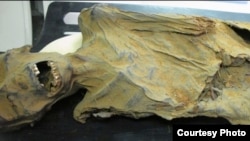
Coronary artery calcifications were found in this mummy of Ahmose Meyret Amon, an Egyptian princess who was between 40 and 45 years when she died. She lived about 1580–1550 BCE and was found near modern day Luxor. (The Lancet)
Hardening of the arteries, or atherosclerosis, is often described as a lifestyle disease resulting from smoking, poor diet, and a lack of exercise.
Now, a team of U.S. scientists has found new evidence that the disease has been around since long before our modern lifestyle.
The researchers examined CT, or “cat” scans of 137 mummies for signs of the artery disease.
Randall Thompson of the University of Missouri-Kansas City says researchers found definite or probable evidence in about one-third of the preserved corpses.
"We’ve concluded that this disease is inherent to human aging," Thompson said at a meeting of the American College of Cardiology, "and that it’s not particularly characteristic of any diet or lifestyle."
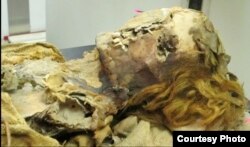
This mummy of an Egyptian woman who was between 45 and 50 years old when she died, is from an unknown era and shows evidence of heart disease. (The Lancet)
The mummies were mostly from ancient Egypt and Peru, plus a small number from what is now Utah in the United States, and the Aleutian Islands off Alaska - populations, in other words, with a range of diets and lifestyles across a 4000-year timespan.
It’s commonly thought that atherosclerosis, and cardiovascular disease in general, is related to our modern sedentary lifestyle. But Thompson noted that when they examined Aleutian mummies, all from a 19th century society of hunter-gatherers, three of the five bodies showed signs of hardening of the arteries.
“Now, one of the Aleutians who had this disease would have had a traditional lifestyle like her people had had for a very long time, hunting from kayaks and so forth," Thompson said. "And she had very extensive coronary calcifications, the kind of calcifications we see in our modern patients, the patients who need bypass surgery.”
Atherosclerosis can lead to heart attacks, but not always. The researchers say they can’t be certain whether the artery disease they found in the mummies was fatal.
But co-author L. Samuel Wann of Saint Mary’s Healthcare in Milwaukee, Wisconsin, says some ancient Egyptian writings describe a familiar medical emergency, “and there are paintings on some tombs in Egypt that show people falling over, clutching their chest, as if they are having a heart attack.”
The study by Randall Thompson and his colleagues is published in The Lancet.