



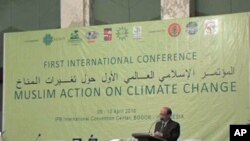
With a population of 1.4 billion and control of the world's largest oil reserves, Muslim communities can play a crucial role in protecting the environment. There is a new effort to organize an international green movement within the Islamic community.
An environmental movement is emerging within the Islamic world. Devout Muslims say there is no contradiction between their faith and environmental protection, and, they say, global warming does not discriminate by region or religion.
Environmental activist Mahmoud Akef with the Earth Mates Dialogue Center was among about 200 Muslim delegates from around the world at a recent environmental conference in Jakarta.
"Because we are all living on this Earth and what is happening, or what's affecting with regard to the climate change, affecting Americans, affects the Muslims here in Indonesia, affects Egypt, Muslims in Africa and Asia anywhere," Akef said.
Climate experts and environmental activists say that burning fossil fuel contributes to global warming. The environmental movement has long focused most of its resources on lobbying for change in Western nations.
But they say many Muslim-majority countries have done little to limit pollution from factories and automobiles, and have allowed the exploitation of natural resources like large scale clearing forests in Indonesia.

Akef says Muslim environmentalists want to spread the message. For instance, they want to create a green Hajj, the pilgrimage in Mecca that three million Muslims make each year, to raise awareness about global warming. The plan includes a ban on plastic bottles at Hajj sites and workshops about the link between environmental stewardship and the teaching of Islam.
"The Koran is kind of ecology book. A lot of verses tell about the environment and how to deal with the environment and how to protect the environment," Akef said.
They are also planning to designate eco-friendly mosques and publish the Koran with paper from sustainable forests.
Muhammad Sembiring, with the Indonesian environmental organization Kehati, says these Muslim activists see no conflict between science and faith on the issue of the environment.
"It is proven there is totally no conflict, it is really [a] complement and it is shaking hands, it is matching," Sembiring said.
He says the beginning of an environmental movement in the Muslim community represents a significant step toward a global consensus on climate change.