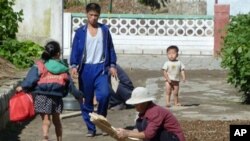
The United Nation's Food and Agriculture Organization (FAO) says a combination of poor harvests, drops in donations, and rising regional food prices could leave North Korea short of food this year by about 600,000 tons.
That means up to six million people, a quarter of the population, would not get enough to eat in a country where a third of all children are already malnourished and have stunted growth.
North Korea’s communist leaders last year cut public rations to half of the body’s daily requirement, down to just 370 grams per person per day.
Hiroyuki Konuma, the FAO representative for Asia, was in North Korea this past week to discuss the food situation with government officials. He told the Foreign Correspondents Club of Thailand that rations were being further reduced.
"We really seek a strong understanding of donor communities for food aid," he said.
The World Food Program (WFP) launched an emergency appeal to donors earlier this year after a rough winter destroyed crops. WFP spokesman Marcus Prior said they have only received about a third of the $209 million required to achieve their goals.
"In August we were able to reach only one percent of all the people we were targeting for food assistance simply because we didn’t have the food in country," he said. "We're hopeful of reaching everybody, but with a reduced ration."
Prior said they were able to convince officials in Pyongyang to grant more leeway to their aid-tracking operations. For the first time they are allowed to have Korean speaking staff, make nationwide visits to markets and use an online food-tracking system.
Questions about transparency linger
But some analysts remain skeptical of Pyongyang’s reported shortfalls. The self-isolated and impoverished nation has for decades struggled to feed its own people while simultaneously directing huge sums of money to the military and ruling elite.
"There's a considerable degree of mistrust between the South and the North and the U.S. and the North, over both the failure to de-nuclearize and over whether the food situation is really as bad as it seems," said Brian Bridges, professor of politics at Hong Kong's Lingnang University.
Pyongyang’s historic lack of transparency in distribution of food aid raises suspicions that at least some funding may be diverted to the military or, perhaps, upcoming national festivities in recognition of the country’s founder, Kim Il Sung.
"With the 100th anniversary of Kim Il Sung's birth rapidly approaching," said Bridges, "it is possible officials would store food away from the general populace in preparation."
At this point in time, the U.S. and South Korea are reluctant to resume regular donations.
North Korea in 2009 pulled out of talks aimed at ending its nuclear programs in return for aid and diplomatic incentives.
N. Korean Aid Shortages Prompt Outreach, Questions