



Did you wonder this morning whether you should pack an umbrella before leaving home? Or whether ultraviolet rays or air quality issues might pose particular problems, if you had to be outside all afternoon? For some, these questions might have been more serious - whether wildfires or floods were going to spread to your town, for example.
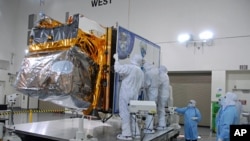
The information to answer questions like these comes from above. And researchers are expecting big things from NASA's newest Earth-observing satellite. A bus-sized box of instruments that will orbit some 800 kilometers above the Earth is expected to help everyday people and scientists make some important decisions. NASA's newest environmental satellite is known as the NPP (National Polar-orbiting Operational Environmental Satellite System Preparatory Project), launched from California on Friday, October 28.
Ken Schwer is the NPP project manager at NASA's Goddard Space Flight Center in Maryland.
"With climate studies, enhanced weather forecasting, and monitoring of critical events, NPP's bumper sticker could read 'NPP - Our Planet's Lifeguard,'" he told reporters at a pre-launch briefing.
NASA says the NPP will orbit the Earth about 14 times a day, and it will observe almost the entire surface of the planet. The 2,100 kilogram spacecraft carries five key instruments that will monitor atmospheric moisture and air pressure, Earth's ozone levels and radiation, and collect visible and infrared views of wildfires, land changes and ice sheet movement.
Weather vs climate
Jim Gleason is the NPP project scientist based at Goddard. Gleason says the NPP is the first mission designed to provide observations for weather forecasters and climate researchers.
Gleason notes that weather is about conditions in the near future, while climate is about weather patterns over long periods of time.
"It's incredibly valuable to try to understand what the future environment may bring, and the future environment is as much about tomorrow's weather as it is long-term climate change," said Gleason.
Gleason is particularly interested in the Earth's ozone layer. He says new data will help scientists evaluate the effectiveness of policies that were adopted in the 1980s to reduce the levels of ozone-depleting substances in the atmosphere.
Mitch Goldberg, a scientist at the U.S. National Oceanic and Atmospheric Administration, or NOAA, says his agency's last weather satellite was launched in 2009 and has a three-year life expectancy.
"The launch of NPP is critical for NOAA and NASA, for the United States and for the international community," Goldberg said. "NPP represents a bridge from current NOAA operational and NASA research satellites to the future operational platforms known as the Joint Polar Satellite System, JPSS. And it will provide essential and improved atmospheric, oceanic and terrestrial observations for many different applications."
NPP has a five-year mission life, and it will bridge the gap until the JPSS is launched in 2015.
Extreme weather
Scientists say NPP will improve forecasting of extreme events five to seven days in advance and its instruments will become the foundations of a global observing system.
Mitch Goldberg works as a JPSS program scientist.
"Forecasts are used to make decisions in order to save lives, mitigate property loss, and make millions of day-to-day and longer term decisions across all economic sectors affected by weather, such as transportation, agriculture, construction, energy and tourism," explained Goldberg. "In 2011 alone [in the United States], there have been 10 separate weather events, each inflicting at least $1 billion in damages, including tornado outbreaks, fires, hurricanes, floods and blizzards. NPP will provide improved information to forecasters and emergency managers to better warn and prepare the public for severe weather events."
Goldberg says the satellite will also be used to track ash plumes from volcanic eruptions to help ensure aviation safety. It will monitor fire- and drought-risk conditions, and map vegetation - all of which are important to food security. It will measure variations in land ice, sea ice and glaciers to quantify changes in the global climate. And it will detect harmful algae blooms that could threaten fisheries, coastal eco-systems and people's respiratory health.