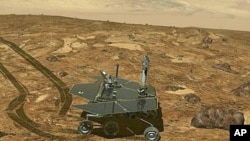



NASA has sent its Mars Rover, Opportunity, on its first winter working vacation since the solar-powered vehicle began exploring the red planet’s surface several years ago.
Similar to humans who travel to sunny locations during the winter, the robotic rover will spend the next several months literally soaking up sunlight. The U.S. space agency, NASA, says it positioned Opportunity with its solar panel angled toward the Sun to make sure the rover will have enough power to last for the duration of the long Martian winter.
Mission scientists say it was not necessary for Opportunity to be kept in a Sun-facing position the previous four Martian winters because its landing site just south of the planet's equator gets relatively strong sunlight year-round. They decided to use the maneuver this year because the rover’s solar panels were caked with an unusually thick coating of dust.
NASA says Opportunity is sitting on the slope of a rocky outcrop that lies along the rim of Mars’ 22-kilometer-wide Endeavour Crater. Scientists say they have identified a variety of interesting features for the rover to investigate with its robotic arm while its solar panels store up energy from the Sun. NASA says it does not plan to move the golf cart-sized vehicle more than a meter or two until June or July when Opportunity will resume its current mission exploring Endeavour Crater.
Opportunity’s twin rover, Spirit, was at a landing site farther from the equator, and spent all three of its Martian winters tilting it solar panel toward the Sun. Spirit is no longer functioning. It stopped communicating with mission control on Earth in March 2010.
Even though the rovers landed on Mars in early 2004, they are now just entering their fifth Martian winter. That is because one year on Mars - the time it takes the planet to make one complete a solar orbit - is nearly twice as long as one year on Earth. That is, it takes Mars the equivalent of 687 Earth-days to make one lap around the Sun, while the Earth's solar orbit is complete in 365 days.
NASA says the site where Opportunity is spending the winter is informally named “Greeley Haven,” in honor of late planetary geologist Ronald Greeley, who was a member of the science team for the Mars rovers and other missions. Greeley died in October. Rover scientists hope to have the name made official.
NASA launched the Mars rovers Opportunity and Spirit in 2003. Their separate missions exploring the Martian surface were only scheduled to last for three months - until April 2004 - but both rovers continued operating for many years longer. NASA launched its newest Mars rover, Curiosity, in late November 2011. It is scheduled to touch down on the Martian surface in August.
Mars is one-third the size of the Earth. It is the fourth of eight planets in our solar system. Mars orbits the Sun between the Earth and the massive gas-giant planet, Jupiter.
The U.S. space agency is exploring Mars to learn more about its geological structure, climate and environment, as well as to search for evidence whether the planet had a habitable environment billions of years ago, before the loss of its magnetic field and atmosphere turned it into the dry, dusty, frozen world it is today.
NASA Rover Takes 'Winter Vacation' to Power Solar Panel