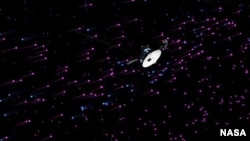
The Voyager 1, operated by the U.S. space agency NASA, has entered a newly discovered region at the edge of the solar system, and is close to crossing a final boundary into instellar space.
Scientists are calling this region between between the solar system and deep space the "magnetic highway." Astronomers say Voyager is still under the influence of our Sun, but that it has reached an area in which highly charged energy particles from interstellar space are beginning to stream in.
Project scientist Edward Stone of the California Institute of Technology says astronomers did not previously know about this final boundary discovered by Voyager.
"It's a magnetic highway where the magnetic field of the Sun was still inside apparently. But the magnetic field now is connected to the outside, letting particles in and out."
Stone says it could be another two to three years before Voyager crosses that magnetic highway. The latest discovery from Voyager was described by astronomers at the American Geophysical Union meeting in San Francisco on Monday.
NASA Animation - Voyager 1 Explores the Magnetic Highway:
In this region, the sun's magnetic field lines are connected to interstellar magnetic field lines, allowing particles from inside the heliosphere to zip away and particles from interstellar space to zoom in.
Voyager 1 and it's twin space probe Voyager 2 were launched 16 days apart in 1977. At 18 billion kilometers away, Voyager is the the most distant human-made object. Voyager 2 is about 15 billion kilometers away. A signal from Voyager 1 takes about 17 hours to reach Earth.
Stone says Voyager 1 has enough power to keep operating all of its instruments until 2020.
"At that point, we will have to turn off our first instrument," he said. "And by 2025, the power will have decayed away enough that we will have to turn off the last of the instruments."
This is the farthest any earthly spacecraft has journeyed away from our planet.
Scientists are calling this region between between the solar system and deep space the "magnetic highway." Astronomers say Voyager is still under the influence of our Sun, but that it has reached an area in which highly charged energy particles from interstellar space are beginning to stream in.
Project scientist Edward Stone of the California Institute of Technology says astronomers did not previously know about this final boundary discovered by Voyager.
"It's a magnetic highway where the magnetic field of the Sun was still inside apparently. But the magnetic field now is connected to the outside, letting particles in and out."
Stone says it could be another two to three years before Voyager crosses that magnetic highway. The latest discovery from Voyager was described by astronomers at the American Geophysical Union meeting in San Francisco on Monday.
NASA Animation - Voyager 1 Explores the Magnetic Highway:
In this region, the sun's magnetic field lines are connected to interstellar magnetic field lines, allowing particles from inside the heliosphere to zip away and particles from interstellar space to zoom in.
Voyager 1 and it's twin space probe Voyager 2 were launched 16 days apart in 1977. At 18 billion kilometers away, Voyager is the the most distant human-made object. Voyager 2 is about 15 billion kilometers away. A signal from Voyager 1 takes about 17 hours to reach Earth.
Stone says Voyager 1 has enough power to keep operating all of its instruments until 2020.
"At that point, we will have to turn off our first instrument," he said. "And by 2025, the power will have decayed away enough that we will have to turn off the last of the instruments."
This is the farthest any earthly spacecraft has journeyed away from our planet.