


A power struggle in Nepal between the government of Prime Minister Madhav Kumar Nepal and the Maoists, who hold the most legislative seats, is seeing the local folk and foreign tourists caught in the middle. Since May Day, most of the country has ground to a halt with a Maoist-initiated strike intended to force the collapse of the year-old government.
In the middle of an intersection in Kathmandu, villagers from the remote northwest mountainous Karnali zone -- one of the poorest in Nepal -- sing and dance in a circle around a traffic control post.
While riot policemen sit nearby, paying little attention to thousands of Maoist supporters and spectators milling in the avenues deserted of vehicles, the Karnali villagers sing a Maoist-inspired ditty calling for the prime minister to resign.
This is part of what one Maoist leader calls a "peaceful war" to install a people's government in Nepal.
Markets here are only permitted by the Maoists to open two hours per day in the evening for people to buy food and other necessary supplies.
Only a few shops, restaurants or hotels in the capital are willing to defy the ban on commerce.
Some merchants in the Thamel tourist district signal furtively to passing foreigners that they are potentially open for business.
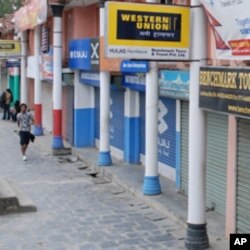
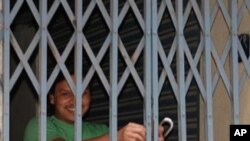
The shutters go up to allow the customers to enter and then are quickly brought down again.
Stick-wielding Maoist cadres can be seen patrolling for violators. Merchants say those who defy the ban and do not pay extortion money to the Maoists are often being threatened with violence.
At the front desk of the Hotel Mandap, manager Binaya Thapa Magar was asked by VOA News how long his establishment could hold out before suffering a financial disaster.
"Five more days or six days. It's difficult but somehow we'll survive, I hope. If this political situation would not be solved, the situation would be the worst. This must be solved," Magar said.
The Maoists say the strike will continue until the prime minister quits. But they have also issued a long list of other demands in recent days.
Chinese tourist Vianne Cai sits in a bicycle rickshaw, one of the few means of transport around the capital. She's visiting with two girlfriends from Beijing. Cai says they've never experienced anything like this. Cai says because it's such an unusual situation it is a bit exciting, but there is confusion and the inconvenience of not being able to easily move around the city or visit any shops.
Richard Gardner and his wife, Samanthi Selva, from Sydney Australia, walk on a nearly deserted lane usually bustling with tourists and hawkers. They just returned from a trek to the Mount Everest base camp and had planned to spend five days in the capital.
"There's really nothing we can do," he said. "We can't really do any sightseeing, it's a bit of a hassle to try and plan to go to Pokhara (200 km west of Kathmandu) or anywhere else in the country at the moment."
"You can see nothing is open, so, yeah, all our plans at the moment are kind of hindered in the fact that there's a strike on," Selva stated. "Unfortunately, not much to do. And we're not very happy, but what can we do?"
The Maoists have ordered all motorized forms of transport off the roads -- except for ambulances, water delivery and garbage removal trucks and diplomatic and media vehicles, as well as special airport buses for the stranded tourists.
Some visitors say they are giving up, unsure how long the strike will continue.
Tourism officials confirm thousands of foreigners are trying to fly out of Nepal early, taking with them spending money this poor Himalayan nation's struggling economy, so dependent on tourism, desperately needs.