


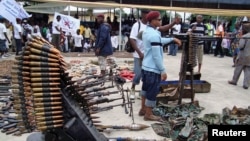
The president of the Africa League for the Control of Arms Coalition said he hopes a U.N. conference on conventional arms trade will have an impact on Africa’s conflict zones. Some 2,000 representatives from member states, international and regional organizations and civil society are taking part this month in the U.N. Conference on the Arms Trade Treaty. The aim is a legally binding treaty on the global trade of conventional weapons.
Baffour Amoa said he hopes a treaty will stem the flow of illicit weapons throughout the continent.
“If they [participants] were able to negotiate successfully this treaty, the hope is that transfers of weapons will become more stringent,” he said. “Third parties will be more careful in assessing the risk associated with each transfer before the transfer is affected, and we believe that these high standards will reduce the excessive flow of illegal weapons into many parts of the world.”
As one example, Amoa said, if third parties in Niger could have better policed weapons flowing out of Libya, they might have been able to prevent arms proliferation into Mali, where a group of Tuareg separatists later fought off the army to declare independence in the north.
“One of the items that’s being negotiated under this treaty is that third parties will be more accountable in terms of shipments and transshipments,” he said. “For example, weapons that were taken from Libya could have been checked in Niger and other transit locations.”
Amoa added another benefit to arms control in sub-Saharan Africa could be the strengthening of regional agreements.
“If you take the ECOWAS [Economic Community of West African States] sub-region, you discover that most of the states are now being responsible in term of weapons transfer management... but you still get weapons coming from other places,” he said.
The U.N. conference, the first of its kind, runs from July 2-27.
Baffour Amoa said he hopes a treaty will stem the flow of illicit weapons throughout the continent.
“If they [participants] were able to negotiate successfully this treaty, the hope is that transfers of weapons will become more stringent,” he said. “Third parties will be more careful in assessing the risk associated with each transfer before the transfer is affected, and we believe that these high standards will reduce the excessive flow of illegal weapons into many parts of the world.”
As one example, Amoa said, if third parties in Niger could have better policed weapons flowing out of Libya, they might have been able to prevent arms proliferation into Mali, where a group of Tuareg separatists later fought off the army to declare independence in the north.
“One of the items that’s being negotiated under this treaty is that third parties will be more accountable in terms of shipments and transshipments,” he said. “For example, weapons that were taken from Libya could have been checked in Niger and other transit locations.”
Amoa added another benefit to arms control in sub-Saharan Africa could be the strengthening of regional agreements.
“If you take the ECOWAS [Economic Community of West African States] sub-region, you discover that most of the states are now being responsible in term of weapons transfer management... but you still get weapons coming from other places,” he said.
The U.N. conference, the first of its kind, runs from July 2-27.
