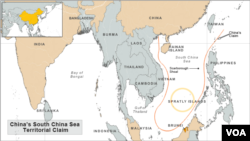
STATE DEPARTMENT — China's move to base troops on a disputed island in the South China Sea has raised concerns about a possible military confrontation in an area where China, Vietnam, Malaysia, Taiwan, Brunei and the Philippines all have competing claims.
Sansha City
China's newest city and military garrison is on an island that also is claimed by Vietnam and Taiwan, at a time of increasing tension over mineral and transport rights in the South China Sea.
"The establishment of Sansha City is a wise decision by the Chinese Communist Party's Central Committee to safeguard national sovereignty and security," said Xiao Jie, the First Mayor of the new Sansha City. "To strengthen the protection of resources and overall development in the South China Sea."
Beijing plans to use its Sansha base to increase patrols in waters claimed by Vietnam and the Philippines.
Dispute over terrority
The Philippines refuses to recognize the establishment of Sansha City.
Lawmaker Walden Bello serves on the Philippine House of Representatives' Foreign Affairs Committee. "This is a move that only falls within China's territorial land-grabbing logic," he explained. "And it is an illegitimate move to set that up."
Analysts say that pushing ahead with Sansha City demonstrates China's confidence in the standoff.
Justin Logan is Director of Foreign Policy Studies at the Washington-based Cato Institute. He says that confidence might be misplaced. "I think there is danger for miscalculation -- for the Chinese overplaying their hand and someone crossing someone else's 'red line' [i.e., limits] unknowingly," he said.
Protests
Analysts say China has countered Philippine and Vietnamese protests by using Cambodia to divide the Association of Southeast Asian Nations, or ASEAN.
Logan says China might be overplaying its hand with the Sansha garrison because troops on the ground are hard to explain away. "There are certain countries, obviously Cambodia, and other countries in the region and in ASEAN, that have been more or less willing, for a variety of different reasons, to be supportive of China in this context," he added. "And I think that this could really put pressure on them to say, 'Look, we can't back you up on this. Maybe we will just sort of sit this out or we won't make a statement on it at all.'"
U.S. State Department Spokeswoman Victoria Nuland says the dispute cannot be resolved by force. "We remain concerned should there be any unilateral moves of this kind that would seem to prejudge an issue that we have said repeatedly can only be solved by negotiation, by dialogue and by a collaborative diplomatic process among all of the claimants," she stated.
Although the United States has no territorial claim in these waters, the Obama administration says no nation can fail to be concerned by the increase in tensions and confrontational rhetoric over the South China Sea.