



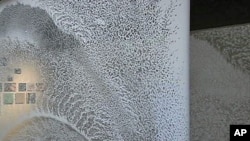
A new art exhibit at the Japan Society in New York City opened just one week after the nation was hit by an earthquake, tsunami and a nuclear plant shutdown. While the exhibit was planned and the art was created long before those disasters, the tragedy seems to be coloring the view of visitors to the show, which continues through mid-June.
The Japan Society exhibit is billed as "Bye, Bye Kitty!!! Between Heaven and Hell in Contemporary Japanese Art." The curators say the show challenges Japan’s love affair with cuteness.
The first image in the exhibit, called "Ash Colored Mountains," sets a serious tone. The work, by Makoto Aida, is reminiscent of a Chinese landscape and depicts the conformist Japanese salaryman, or white collar worker.
Gallery Director Joe Earle said some visitors see a parallel between this image and the piles of debris left by the tsunami. "This exhibition represents a more mature view, if you like, a more mature worldview, one which can take account of catastrophes like earthquakes, problems at nuclear plants and tsunamis."
Earle said neither the exhibit nor the artists anticipated the disasters.
But Kent Bernard, a visitor to the show, said the art could be viewed differently because of recent events in Japan. "The things which you normally just do not see, except in artwork, we’re now seeing in real life. It sort of reminds you that some of the more fantastical things in art are outdone by nature."
Bernard points to "Vortex" by Tomoko Shioyasu. The artist sought to represent nature, particularly over time, in such things as rocks, trees, water channels, and in cells. But "Vortex" bears an uncanny resemblance to the whirlpool created by the recent tsunami.
Earle said much of the exhibit displays a sense of fragility and looming disaster. This is clear in Manabu Ikeda’s "History of Rise and Fall."
"Up in the top left hand corner, we have the contrails left by attacking jets or missiles from North Korea, an incident that actually happened during the long period Ikeda was producing this painting in 2006," said Earle.
The prospect of nuclear obliteration is coupled with images of mass executions, a demon lurking beneath roof tiles, people on a tightrope over a precipice, and a waterfall representing waste passed from one generation to another.
Earle said the artist may be uncomfortable with an interpretation that includes radiation now escaping from Japan's nuclear plants because the painting predates the disaster.
At least one visitor from San Francisco, however, made the connection anyway. "That decay of humanity and decay of our environment, that may have been one that I more resonated with in terms of feeling like you’ve captured life and that it really does decay under you, and what you’re attached to may be very ephemeral."
As a New York Times reviewer put it, the anxiety depicted in the current exhibit stands out more in light of Japan’s real-life disaster.